How Much Does Music App Development Cost in 2026?
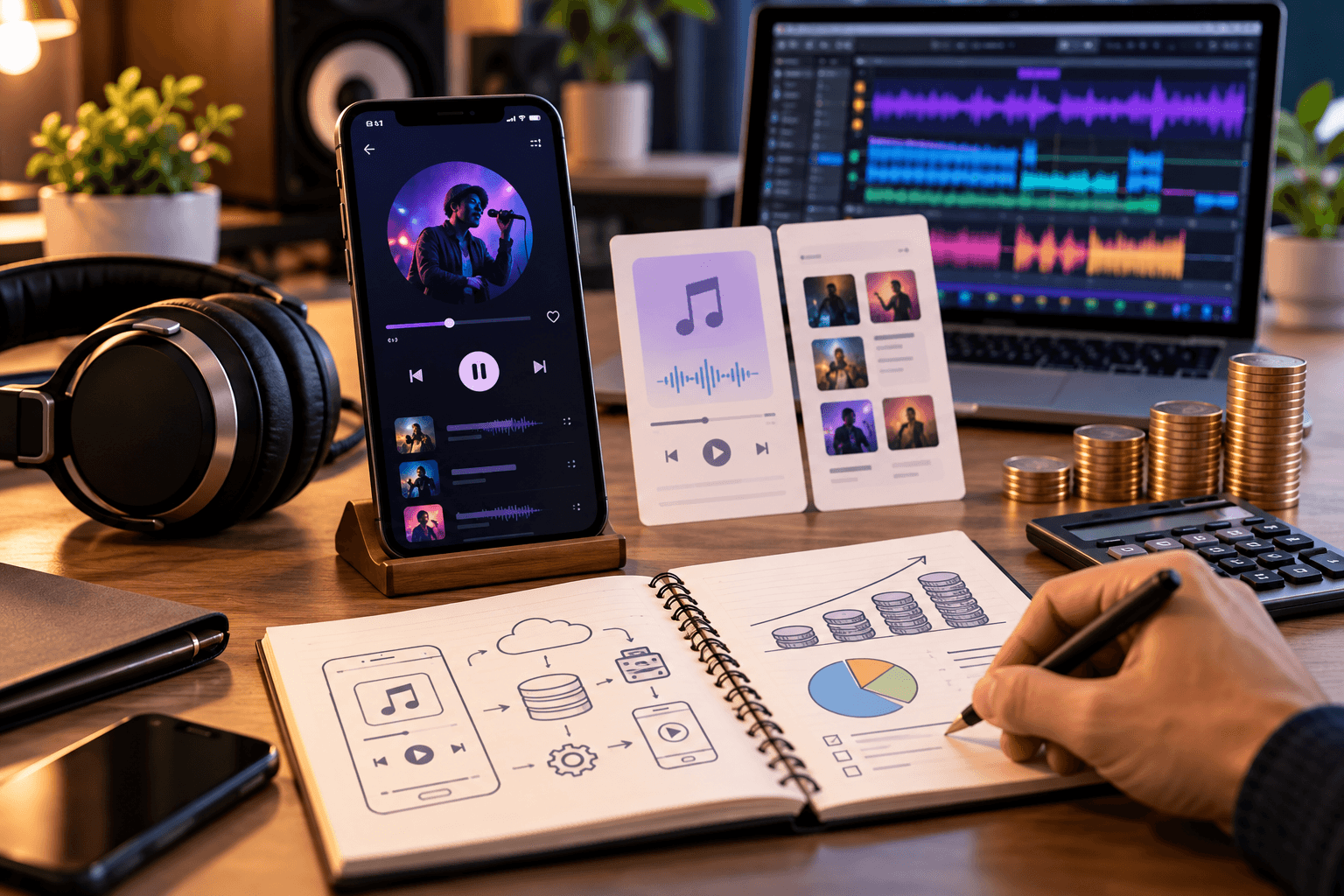
Music app development costs between $20,000 and $400,000 or more in 2026, depending on app type, feature complexity, and platform.
A basic music player with offline playback and a curated library runs $20,000 to $50,000. A mid-tier streaming app with personalized recommendations and social features costs $70,000 to $180,000. A full-scale platform comparable to Spotify or SoundCloud with licensing infrastructure, AI-powered discovery, and creator tools reaches $180,000 to $400,000 and beyond.
What nearly every cost guide leaves out: music licensing is often a larger ongoing expense than the app development itself, and planning for it as an afterthought is the single most common way music app projects run out of budget before launch.
What Kind of Music App Are You Building?
Most cost breakdowns for music apps collapse everything into "basic," "medium," and "advanced" tiers without explaining what the actual differences are. That framing misleads budgets. The type of app you're building changes the cost structure entirely.
Music streaming apps (Spotify, Apple Music, Tidal model) are the most infrastructure-heavy category. Core functionality includes catalog search, curated playlists, offline downloads, audio quality tiers, and recommendation algorithms trained on listening history. The backend must handle thousands of concurrent audio streams with low latency, which means significant CDN and cloud infrastructure spend from day one.
Music creation and DAW apps (GarageBand, BandLab, Soundtrap model) require real-time digital audio workstation functionality: multi-track recording, effects chains, MIDI sequencing, sample libraries, and low-latency audio I/O. This is technically the hardest category to build well, because audio latency tolerances are far tighter than any other app type. A 20ms input delay is unacceptable in a DAW; users in a streaming app won't notice it.
Social music platforms (SoundCloud, Bandcamp model) combine audio hosting with community features: artist profiles, follower networks, comment threads, licensing options for creators, and revenue sharing infrastructure. The complexity scales with how much creator tooling you add.
Podcast and audio content apps (Spotify Podcasts, Podbean, Overcast model) carry a different licensing structure. Podcast RSS is largely open, so the licensing layer is simpler than music streaming, but these apps require strong search, episode management, chapter markers, download queues, and cross-device sync.
Live performance and social audio apps (Bandsintown, Jamulus, Stage model) handle real-time multi-user audio, which is a distinct engineering challenge from async streaming. Latency requirements are severe, and geographic proximity matters for connection quality.
Knowing which category you're in before getting quotes is the first step to a realistic budget conversation.
Music App Development Cost by App Type
The table below shows typical development cost and timeline for each category of music app.
App Category | Development Cost | Timeline |
|---|---|---|
| Basic music player (local files, simple UI, single platform) | $20,000 - $50,000 | 2 - 4 months |
| Music streaming app core (catalog, search, playlists, offline) | $70,000 - $130,000 | 4 - 7 months |
| Music streaming app mid-tier (recommendations, social features, creator tools) | $130,000 - $220,000 | 6 - 10 months |
| Full-scale streaming platform (AI discovery, multiple quality tiers, licensing integration) | $220,000 - $400,000+ | 10 - 18 months |
| Music creation / DAW app (recording, multi-track, MIDI, effects) | $80,000 - $200,000 | 5 - 10 months |
| Social music / artist platform (SoundCloud model) | $90,000 - $200,000 | 5 - 9 months |
| Podcast and audio content platform | $50,000 - $140,000 | 3 - 7 months |
| Live performance / real-time social audio | $100,000 - $250,000 | 5 - 10 months |
These ranges reflect US-based development at $100 to $175 per hour. Offshore development reduces these figures by 40 to 60 percent, with the same trade-offs that apply to any offshore engagement: a tighter specification upfront, timezone management, and a technical review process on deliverables.
The Budget Line Most Guides Don't Mention: Music Licensing
This is where more music app projects run into serious budget problems than any other single issue.
If your app streams or hosts music from major labels or independent distributors, you need music licenses. "We'll sort that out later" is how apps get their content pulled and their launch delayed by months. The license types that apply are below.
Performance Licenses
Performance licenses cover the right to publicly perform a recording, and streaming a song to a user constitutes a public performance. In the US, this means licensing through ASCAP, BMI, and SESAC for the publishing rights, and separately through SoundExchange for the master recording rights (the actual recorded sound, not just the underlying composition).
Mechanical Licenses
Mechanical licenses apply when users can download or cache songs for offline playback. The Harry Fox Agency or direct mechanical licenses with publishers cover this.
Sync Licenses
Sync licenses apply when music is paired with visual content. If your app includes music videos, lyric videos, or any video-plus-audio combination, sync licensing is a separate and typically more expensive category.
Direct Label Deals
Direct label deals are what Spotify, Apple Music, and Amazon Music rely on. They negotiate comprehensive agreements with the three major labels (Universal, Sony, Warner) and a network of independent distributors (DistroKid, TuneCore, CD Baby, etc.) that cover both performance and mechanical rights for their catalogs.
What Music Licensing Costs
The cost structure looks like this:
Licensing Approach | Cost | What It Covers |
|---|---|---|
| Statutory rates (US mechanical, per-stream) | ~$0.006 - $0.0084 per stream | Cached/downloaded tracks |
| ASCAP blanket license (small interactive streaming) | $500 - $5,000/year minimum, scales with revenue | US public performance (composition) |
| BMI blanket license | Similar structure to ASCAP | US public performance (composition) |
| SoundExchange digital performance license | Royalties split 50% to the label, 45% to featured artists, 5% to non-featured musicians | Master recordings (non-interactive streaming) |
| Direct label licensing | Negotiated, typically 20 - 35% of revenue | Full interactive streaming rights |
Licensing Timelines, Legal Fees, and Alternatives
For an app that wants to license mainstream music for on-demand streaming, direct deals with the major labels and a distribution aggregator are unavoidable. These negotiations take 3 to 12 months and require a legal team experienced in music rights. Budget $30,000 to $100,000 in legal fees for a full licensing program, on top of the royalty obligations themselves.
Apps that avoid the licensing complexity by working with royalty-free libraries (Epidemic Sound, Artlist, Musicbed) or user-generated, creator-uploaded content (SoundCloud's original model) can launch much faster and at a fraction of the ongoing cost. The trade-off is no access to mainstream label catalogs.
Platform Cost Breakdown
Your platform choice affects both the build cost and the audio performance ceiling.
Platform | Cost Impact | Notes |
|---|---|---|
| iOS only (Swift/SwiftUI) | Baseline | Best audio performance via Core Audio framework |
| Android only (Kotlin) | Baseline | Larger device range; audio latency varies more across hardware |
| Cross-platform (Flutter / React Native) | +20 - 35% over single platform | Suitable for non-DAW apps; real-time audio still benefits from native |
| iOS + Android native (two separate codebases) | +60 - 80% vs single platform | Highest performance ceiling; standard for apps where audio quality is a differentiator |
| Web app (PWA or browser-based) | -30 - 40% dev cost, plus platform constraints | No offline audio support on iOS Safari; limited audio codec support |
Native Audio Where It Counts
For music streaming apps where audio quality matters, React Native and Flutter have matured enough for most features: playlist management, search, social features, and payments. Real-time audio processing, low-latency recording, and hardware audio API access still perform best in native code.
A hybrid approach (cross-platform UI with native audio modules) is how many successful mid-tier music apps are now built, keeping costs lower while preserving performance where it counts. For a deeper comparison, see our cross-platform vs native app development guide.
Ongoing Costs After Launch
Building the app is the year-one cost. The recurring cost structure for a music streaming app looks like this.
Audio CDN and infrastructure: Streaming audio at scale requires a CDN built for audio delivery. AWS CloudFront, Cloudflare Stream, or a specialized audio CDN like Mux runs $0.01 to $0.05 per GB delivered. A 100,000-user app streaming 2 hours per user per day at 128kbps generates roughly 11.5 TB per day (about 345 TB per month), which works out to approximately $3,500 to $17,000 per month in CDN costs alone at that scale.
Music licensing royalties: Percentage of revenue or per-stream rates, ongoing. For an app with 10,000 active monthly users streaming 100 songs each, mechanical royalties alone approach $6,000 to $8,400 per month at statutory US rates.
App maintenance: iOS and Android platform updates require active maintenance, and audio APIs change with OS releases. Budget 15 to 20 percent of the original build cost annually.
Audio processing APIs: If you use third-party services for audio fingerprinting (ACRCloud), audio enhancement (Dolby.io), or AI music analysis (Essentia, Cyanite), these carry subscription costs of $500 to $5,000 per month depending on volume.
Artist and label payments: For platforms with revenue sharing, payment processing and royalty calculation systems add operational complexity and transaction costs.
The licensing and infrastructure costs mean a music streaming app's total annual operating cost often equals or exceeds its original development cost within 18 to 24 months. This is the number most early-stage music app business plans underestimate.
When Music App Investment Makes Business Sense
These are the clearest ROI models in music app development in 2026.
Niche Genre and Community Platforms
The market where Spotify and Apple Music dominate is broad-catalog streaming, and competing there directly requires label deals and years of catalog depth. Niche genre platforms (classical, jazz, gospel, metal, traditional music from specific regions) serve underserved audiences that major platforms handle poorly. Licensing costs are dramatically lower for independent and catalog-era recordings, and community features drive retention better than an algorithm ever can.
Creator Tools and DAWs
GarageBand, FL Mobile, and BandLab collectively serve hundreds of millions of users, but the market for professional-grade mobile recording tools is still surprisingly thin. Musicians who record and produce on mobile are a real and growing audience. Creator apps monetize through subscriptions to premium features rather than music licensing, which simplifies the cost structure considerably.
B2B Audio Tools
Background music for retail, restaurants, and hospitality is a multi-billion dollar industry running largely on companies like Soundtrack Your Brand and Mood Media. This is a B2B SaaS model rather than a consumer subscription, with higher contract values and clearer ROI framing for customers.
Fitness and Wellness Audio
Peloton's model of original instructor-designed music licenses, meditation app audio libraries, and sleep app soundscapes are all producing revenue without the label licensing complexity of interactive streaming. The original audio production model trades ongoing licensing costs for upfront content production costs, which are more predictable and controllable.
For businesses in music tech, fitness, hospitality, or creator tools exploring an audio app build, our mobile development team can scope the right architecture for your use case, including a realistic licensing cost estimate that belongs in your budget from day one, not as a surprise after launch.
Building a Music App?
Building a music streaming app, creator tool, or audio platform? HBOX Digital develops custom music apps for startups and scale-ups across the US, from niche streaming platforms to professional DAW tools and B2B audio solutions. Talk to our music app development team. We'll scope the technical and licensing requirements before any code is written.