
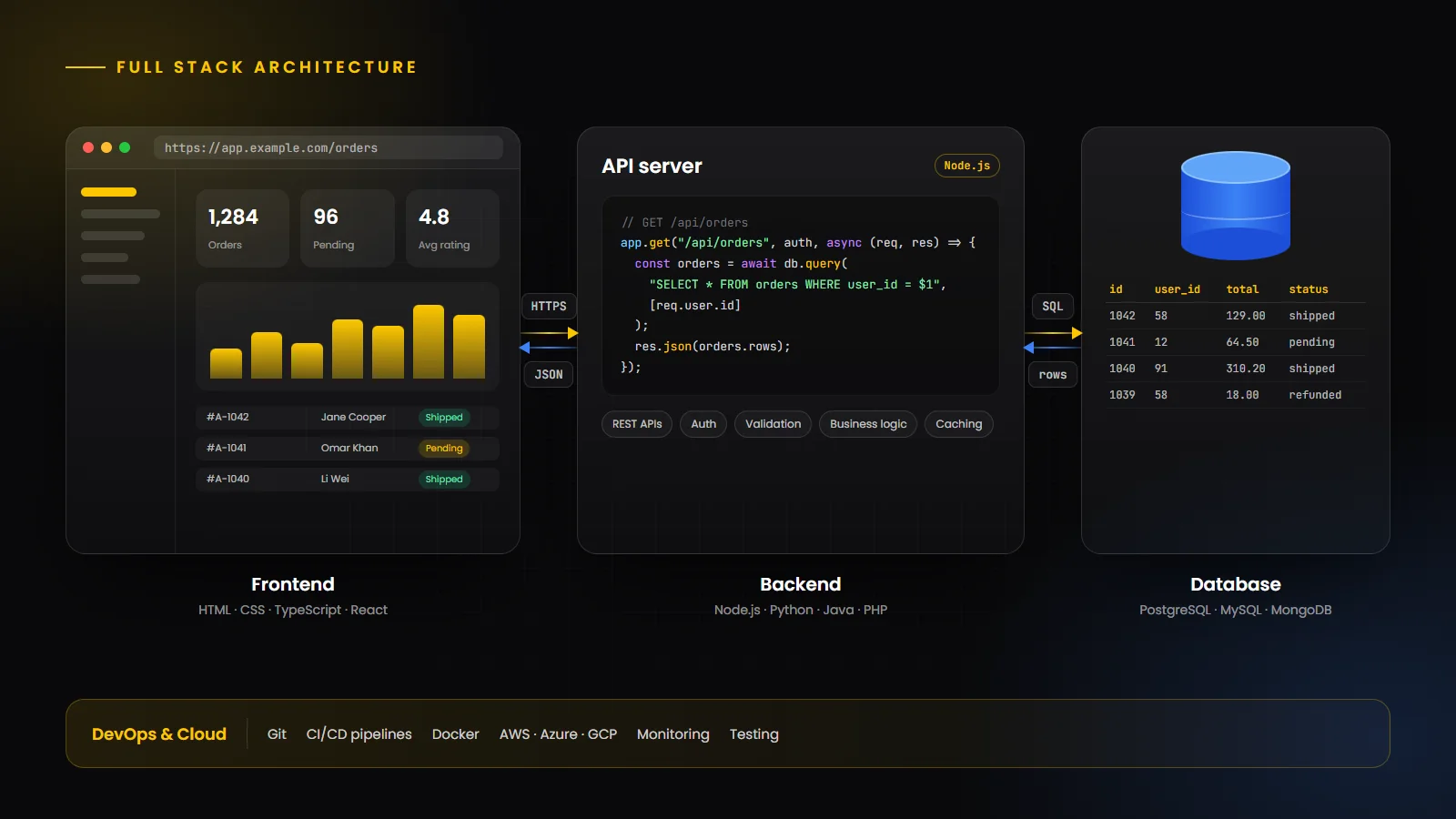
What is a full stack developer?
A full stack developer is a software engineer who can build and maintain every layer of a web application: the interface people see in the browser, the server code that applies business rules, the database that stores information, and the deployment setup that keeps everything running. Instead of passing each feature between several specialists, a full stack developer can take it from a design mockup to a working, deployed result.
The word “stack” refers to the set of technologies an application is built on. A typical web stack has a frontend layer (HTML, CSS and JavaScript or TypeScript, usually with a framework such as React), a backend layer (a server runtime such as Node.js, Python, Java, PHP or .NET), a data layer (PostgreSQL, MySQL, MongoDB or similar), and the infrastructure that ties them together: hosting, CI/CD pipelines and monitoring. Being full stack does not mean knowing every tool in every layer. It means understanding how the layers connect well enough to ship and debug a feature end to end.
That end-to-end view is why the role is so common. In the Stack Overflow 2025 Developer Survey, “Developer, full-stack” was the largest single role among respondents, at 27%. In practice the title covers everyone from the only engineer at a three-person startup to a senior engineer who moves between frontend and backend teams at a large company.
This guide explains what full stack developers actually do, which technologies matter, how the role compares with frontend, backend and software engineering roles, and what to look for if you plan to become one or hire one.
Frontend vs backend vs full stack development
The three terms describe where in an application a developer spends most of their time. Frontend developers own what users see and touch. Backend developers own what happens on the server. Full stack developers work across both, and the table below summarizes how the roles differ in practice.
Aspect | Frontend developer | Backend developer | Full stack developer |
|---|---|---|---|
| Main focus | What users see and interact with in the browser | Server logic, APIs, data storage and integrations | The whole feature, from interface to database |
| Core languages | HTML, CSS, JavaScript, TypeScript | JavaScript (Node.js), Python, Java, PHP, C#, Go | A frontend language plus at least one backend language |
| Typical tools | React, Next.js, Vue, Angular, Tailwind CSS, browser DevTools | Express, Django, Spring Boot, Laravel, ASP.NET Core, SQL, Redis | A complete framework or stack such as Next.js, MERN or Django with React |
| Key concerns | Accessibility, responsiveness, performance and UX consistency | Security, data integrity, scalability and uptime | Trade-offs across layers and how a change in one affects the others |
| Typical output | Components, pages and design system work | Endpoints, services, schemas and background jobs | Complete, deployable features |
Specialist or generalist?
Neither specialist role is a lesser version of full stack. Large products with complex interfaces, heavy traffic or demanding data workloads need people with deep expertise in one layer. Full stack developers are most valuable where speed, ownership and context matter more than maximum depth: early products, small teams, internal tools, and any feature that touches every layer at once.
Most experienced full stack developers also lean one way. Some are frontend-leaning and strongest in UI architecture; others are backend-leaning and strongest in APIs and data. Knowing which way someone leans is useful whether you are planning your own learning or building a team.
What does a full stack developer do?
Day-to-day work depends on team size and product stage, but most full stack roles include a mix of the following responsibilities.
Building user interfaces: turning designs into responsive, accessible pages and components, managing client-side state, and making sure the interface behaves well on slow networks and small screens.
Designing and building APIs: creating REST or GraphQL endpoints, validating input, handling errors consistently, and documenting how other parts of the system should call them.
Modelling and managing data: designing database schemas, writing queries and migrations, adding indexes when queries slow down, and protecting data integrity.
Handling authentication and authorization: implementing sign-in, sessions and permissions, and making sure every server-side operation checks who is allowed to do what.
Integrating third-party services: connecting payment providers, email, CRMs, analytics, file storage and AI APIs, usually through SDKs or webhooks.
Testing, deploying and monitoring: writing automated tests, maintaining CI/CD pipelines, deploying to cloud platforms, and investigating errors and performance problems in production.
Collaborating across roles: working with designers, product managers, QA engineers and other developers, and translating business requirements into well-scoped technical tasks.
Essential frontend and backend technologies
Specific tools change every few years, but the categories stay remarkably stable. A working full stack developer usually has solid fundamentals in each area below and real depth in one or two of them.
Frontend technologies
HTML, CSS and JavaScript remain the foundation of every web interface. MDN Web Docs is the most reliable free reference for all three, and understanding semantic HTML and modern CSS layout (Flexbox and Grid) pays off for years.
TypeScript adds static types to JavaScript and has become the default for many professional codebases because it catches whole classes of bugs before code runs and makes large refactors safer.
A component framework, most often React, with Vue, Angular and Svelte as common alternatives. Meta-frameworks such as Next.js build on React to add routing, server rendering and data fetching.
Styling and quality: an approach such as CSS Modules or Tailwind CSS, plus a working knowledge of accessibility (semantic markup, keyboard navigation, colour contrast) and web performance, measured with Google’s Core Web Vitals.
Backend technologies
A server runtime and language: Node.js with JavaScript or TypeScript, Python, Java, PHP, C# or Go. Choosing one that shares a language with the frontend, as Node.js does, reduces context switching for small teams.
A web framework for that language, for example Express or NestJS for Node.js, Django or FastAPI for Python, Spring Boot for Java, Laravel for PHP, or ASP.NET Core for .NET.
API design with REST or GraphQL, request validation, consistent error handling, background jobs, caching and rate limiting.
Security fundamentals. The OWASP Top 10 is the standard starting point for the most common web application risks, such as broken access control, injection and security misconfiguration.
Databases and data storage
Relational databases such as PostgreSQL and MySQL handle most business data well: users, orders, invoices and bookings. Knowing SQL, joins, indexes and transactions is essential even when you work through an ORM.
Document databases such as MongoDB suit flexible or deeply nested data, while key-value stores such as Redis are widely used for caching, sessions and queues.
ORMs and query builders such as Prisma, Drizzle, Sequelize, SQLAlchemy or Eloquent speed up development and add type safety, but you still need to understand the SQL they generate when performance matters.
DevOps, cloud and tooling
Git for version control and pull-request workflows; Docker for consistent environments; CI/CD pipelines such as GitHub Actions or GitLab CI to run tests and deploy automatically; and at least one cloud platform, whether AWS, Azure, Google Cloud or a managed platform such as Vercel.
Logging, error tracking and monitoring complete the picture. A feature is not really finished until you can tell whether it is working for real users.
Popular full stack technology stacks
A “stack” is simply a combination of these layers that works well together. These are some of the most widely used combinations and the kinds of projects each one tends to suit.
Stack | Components | Often chosen for |
|---|---|---|
| MERN | MongoDB, Express, React, Node.js | JavaScript end to end; startups and products with flexible data |
| MEAN | MongoDB, Express, Angular, Node.js | Teams that prefer Angular’s structured, opinionated framework |
| PERN | PostgreSQL, Express, React, Node.js | MERN-style development with a relational database and stronger data integrity |
| Next.js + PostgreSQL | Next.js (React), Server Actions and Route Handlers, Prisma or Drizzle, PostgreSQL | SEO-sensitive sites, SaaS products and dashboards in a single TypeScript codebase |
| Django + React | Python, Django or Django REST Framework, React, PostgreSQL | Data-heavy products, admin-heavy tools and teams already using Python for AI or analytics |
| LAMP / Laravel | Linux, Apache or Nginx, MySQL, PHP (often with Laravel) | Content sites, e-commerce and business applications with mature hosting options |
| .NET + React or Angular | ASP.NET Core, C#, SQL Server or PostgreSQL, React or Angular | Enterprise environments already invested in Microsoft tooling |
How to choose a stack
There is no universally best stack. Choose based on the people you have or can hire, the kind of data you store, how much SEO and first-load performance matter, and the platforms you already run. A stack your team knows well usually beats a fashionable one they would be learning on the job.
If you want a deeper look at one popular option, our guide for the Next.js full stack developer covers the App Router, Server Components, Server Actions, databases and deployment in detail.
Skills and tools every full stack developer needs
Technical skill is the obvious requirement, but the developers who do best in full stack roles combine it with judgement and communication.
Technical skills
At the core is the ability to read and write clean, typed code in at least one frontend and one backend language, and to design data models and APIs that are easy to change later. Just as important is debugging across layers: following a problem from a failed network request in the browser, to a server log, to the database query that caused it.
Strong full stack developers also write automated tests at the right level (unit tests for business logic, integration tests for APIs and a small number of end-to-end tests for critical journeys), and they understand performance, caching and the basics of authentication, sessions and access control.
Everyday development tools
Most full stack developers work daily with a code editor such as VS Code or a JetBrains IDE, Git with GitHub or GitLab, browser DevTools, an API client such as Postman or Bruno, Docker for local services, a test runner such as Vitest, Jest or Playwright, and an error-tracking tool in production.
AI coding assistants are now part of many workflows as well. They are useful for boilerplate, exploration and explaining unfamiliar code, but their output needs the same review, testing and security scrutiny as any other code.
Soft skills
Because full stack developers sit between design, product and engineering, communication matters as much as code. The strongest ones ask clarifying questions early, explain trade-offs in plain language, estimate honestly, and document decisions so that the next person can pick up their work without a long handover.
Full stack developer roadmap
The roadmap below is a practical learning order. Each stage ends with a small project, because building something real is what turns knowledge into skill. Timelines vary widely with prior experience and hours per week, so treat the stages as a sequence rather than a schedule.
Stage | What to learn | Milestone project |
|---|---|---|
| 1 | Web fundamentals: semantic HTML, CSS layout with Flexbox and Grid, responsive design, and how HTTP and browsers work | A responsive multi-page website with a contact form |
| 2 | JavaScript and TypeScript: language fundamentals, async/await, modules and the DOM, then TypeScript types | An interactive app that consumes a public API |
| 3 | A frontend framework: React components, props, state, effects, forms and routing | A dashboard with filters, forms and client-side routing |
| 4 | Backend and APIs: a runtime such as Node.js, a web framework, REST design, validation and error handling | A REST API with full CRUD endpoints and input validation |
| 5 | Databases: SQL, schema design, relationships, indexes, migrations and an ORM | Connect the API to PostgreSQL with versioned migrations |
| 6 | Authentication and security: sessions or tokens, password hashing, authorization checks and the OWASP Top 10 | Add sign-up, login and role-based permissions |
| 7 | Testing and deployment: unit and end-to-end tests, Git workflows, CI/CD, Docker and a cloud platform | Deploy the full application with automated tests in CI |
| 8 | Production skills: logging, monitoring, caching, performance and accessibility audits | Monitor the live app, fix real issues and document its architecture |
How to become a full stack developer
Pick one stack and stay with it long enough to finish projects. Switching frameworks every few weeks feels productive but rarely builds depth. A JavaScript or TypeScript stack such as React with Node.js, or Next.js with PostgreSQL, is a common starting point because one language covers both the frontend and the backend.
Build projects that look like real work. A portfolio of complete applications, with authentication, a real database, tests and a live deployment, says far more than a list of finished tutorials. Write a short README for each one that explains the problem, the architecture and what you would improve next.
Learn to read documentation and error messages. Official sources such as MDN and your framework’s own documentation are more current than most courses, and the ability to diagnose an unfamiliar error is one of the clearest signs of a developer who is ready for production work.
Get feedback on your code. Contributing to open source, pairing with more experienced developers or working on a team project exposes you to code review, which is where many good habits are formed.
Formal education helps but is not required. Many full stack developers have computer science degrees; many others came through bootcamps, self-study or adjacent roles such as QA, design or technical support. What employers consistently look for is evidence that you can ship and maintain working software.
Common challenges and best practices
The breadth that makes full stack developers valuable also creates predictable problems. Knowing them in advance makes them much easier to manage.
Common challenges
Breadth versus depth: the stack is wide and keeps changing, and the risk is knowing a little about everything but not enough about anything to solve hard problems.
Context switching: moving between CSS, SQL and deployment configuration in a single day is tiring and can slow down complex work.
Security gaps between layers: many vulnerabilities appear at the boundaries, for example when the frontend hides a button but the API behind it never checks permissions.
Keeping up with change: frameworks release major versions regularly, and dependencies need security updates throughout a product’s life.
Best practices
Go deep in one area while staying competent in the rest, and be honest about which side of the stack you lean towards.
Treat every API endpoint and server function as public. Validate input and check authorization on the server, never only in the user interface.
Use TypeScript and shared types or validation schemas so that a change to a data shape is caught across the whole stack instead of in production.
Automate the repetitive parts: formatting, linting, tests and deployments should run in CI on every change.
Keep frameworks and dependencies patched, and follow the security advisories for the tools you depend on.
Measure before you optimize. Use real data, such as Core Web Vitals and slow-query logs, to decide what to fix first.
Full stack developer vs software engineer
The two titles overlap heavily, and many companies use them interchangeably. The difference is mostly about scope. “Software engineer” is the broader term and covers web, mobile, embedded, systems, data and infrastructure work. “Full stack developer” describes a specific shape of web-focused work across the frontend, the backend and the database.
Aspect | Full stack developer | Software engineer |
|---|---|---|
| Scope | Web applications, from interface to database | Any kind of software, including systems, mobile, embedded, data and infrastructure |
| Typical focus | Delivering complete product features end to end | Varies by specialty; often deeper focus on one domain or layer |
| Common environments | Startups, agencies, product teams and internal tools | Every kind of company, including large platform and infrastructure teams |
| Relationship | A full stack developer is a type of software engineer | Many software engineers work full stack on web products |
Demand, salary and career outlook
Full stack skills map closely to how most web products are built, which keeps demand steady. In the United States, the Bureau of Labor Statistics groups much of this work under web developers and digital designers. It reports a median annual wage of $99,520 for that group (May 2025) and projects employment to grow 5% from 2025 to 2035, faster than the average for all occupations. Full stack developers who work on complex systems are often classified as software developers instead, a category with its own figures. See the BLS Occupational Outlook Handbook for details.
Typical career paths lead from junior to senior full stack developer and then towards tech lead, engineering manager or solutions architect, or into a deeper specialty such as backend platforms, frontend architecture or DevOps. Some move into founding or early-stage startup roles, where the ability to build an entire product is especially valuable.
Hiring a full stack developer
A full stack developer is a strong choice for an MVP, an internal tool or a product that needs one person to own features end to end. As a product grows, most teams add specialists alongside their full stack developers rather than replacing them.
What to evaluate
Look for evidence of shipped and maintained work rather than a long list of technologies. Useful signals include projects with real users, the ability to explain architecture decisions and trade-offs, clean and tested code in a take-home task or pairing session, and a sensible answer to questions such as how they would secure an API or investigate a slow page.
Ask which side of the stack they are strongest on. An honest answer is a good sign, and it helps you plan where you may still need a specialist.
Engagement options
You can hire in-house, work with freelancers, outsource a defined project to an agency, or extend your team through staff augmentation, where a vetted developer joins your workflow under your direction. Each model balances cost, control and speed differently. Our guides to how staff augmentation works and IT staff augmentation costs go into the details.
HBOX Digital provides dedicated full stack and specialist engineers, including Node.js developers, and builds custom software and web applications end to end. You can see how our engineers work inside client teams in our case studies.
Conclusion
A full stack developer connects the pieces of a web application: interface, server, data and deployment. The role rewards curiosity and ownership more than memorizing every tool. If you are learning, focus on fundamentals, pick one stack and build complete projects. If you are hiring, look for people who can explain how the layers fit together and who have shipped software that real people use.
If you need full stack capacity for a new product or an existing codebase, talk to our team about the work you have in mind.