
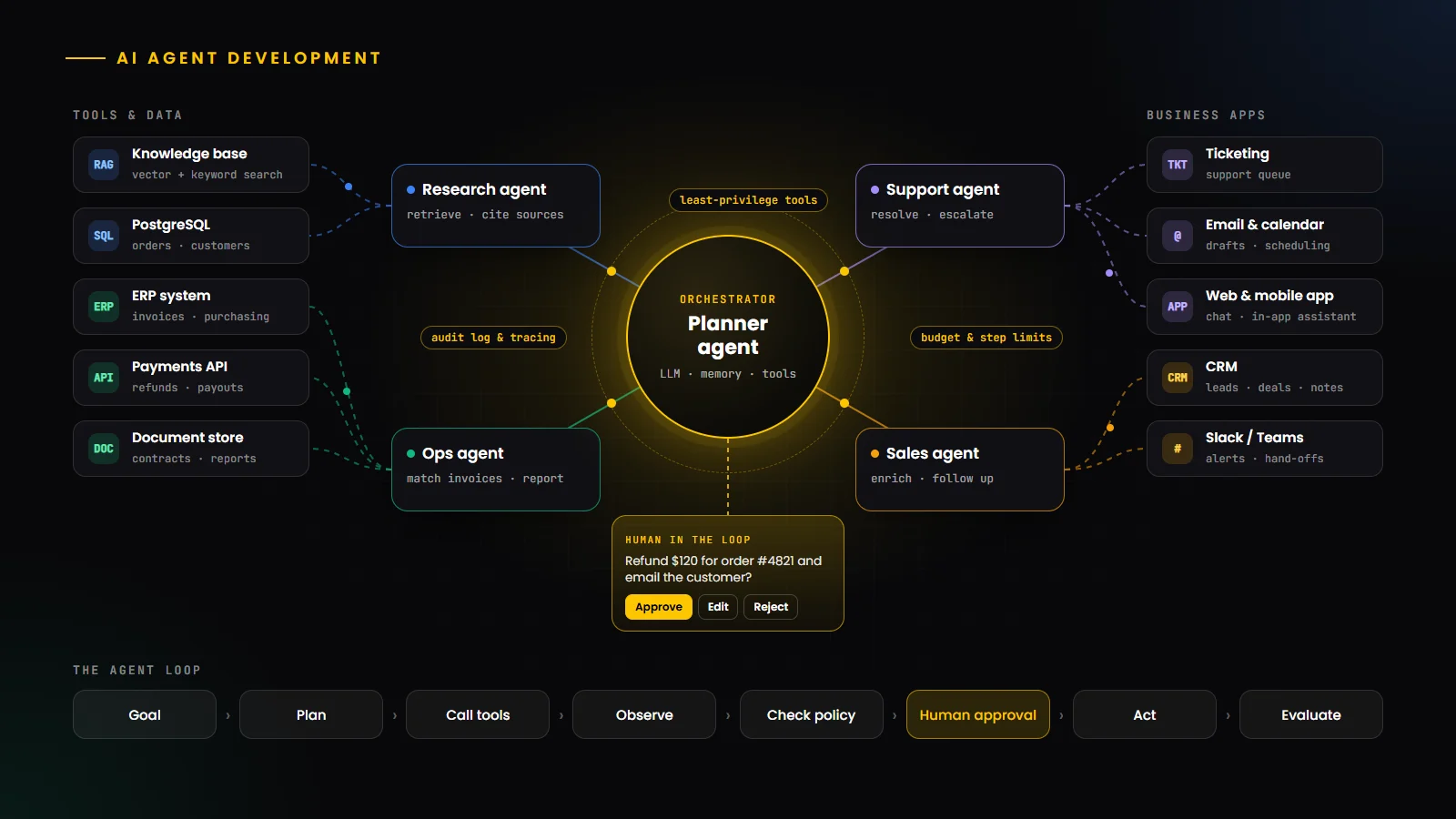
What is AI agent development?
AI agent development is the work of designing, building and operating software agents that use a large language model (LLM) to understand a goal, decide what to do next, call tools such as APIs and databases, and keep going until the task is done or a person needs to step in. A support agent that reads a ticket, checks the order system, issues a refund within policy and drafts the reply is an AI agent. A chatbot that only answers questions from a fixed script is not.
In 2026 the question for most businesses is no longer whether agents work, but where they are worth the effort and how to run them safely. The models are capable, the frameworks have matured and integration standards have settled. What separates a useful agent from an expensive experiment is the engineering around the model: the tools it may call, the data it can see, the checks on what it does, and how its quality is measured over time.
This guide covers that engineering end to end, from the core concepts and architecture to frameworks, security, costs and how to choose a partner. If you are looking at the business case first, our article on how agentic AI improves operational efficiency is a good companion read.
What is agentic AI?
Agentic AI describes systems that pursue a goal with some autonomy rather than responding to one prompt at a time. An agentic system breaks a goal into steps, chooses actions, observes the results and adjusts its plan. Autonomy is a spectrum, not a switch: at one end an agent suggests actions for a person to approve, at the other it completes routine work on its own and escalates only exceptions.
Most successful business deployments sit in the middle of that spectrum. They give the agent freedom to gather information and prepare work, and keep a human approval step for anything that spends money, changes records of consequence or contacts customers in new ways.
AI agents vs traditional AI chatbots
The difference is not the chat window but what happens behind it. The table below summarizes how an AI agent differs from a traditional rule-based or FAQ chatbot.
Aspect | Traditional chatbot | AI agent |
|---|---|---|
| Goal | Answer a question or route a request | Complete a task or reach an outcome |
| Logic | Scripted flows, intents and keyword rules | Model-driven reasoning that plans the next step |
| Actions | Few or none; hands off to a person | Calls APIs, queries data, updates systems within permissions |
| Memory | Usually limited to the current session | Task state plus short- and long-term memory where designed |
| Handling the unexpected | Falls back to a default answer | Re-plans, asks a clarifying question or escalates |
| Main risks | Unhelpful answers | Wrong actions, misuse of tools, cost overruns; needs guardrails |
How autonomous AI agents work
Under the hood, almost every agent runs a loop. It receives a goal and context, the model decides on the next step, the step is executed through a tool, the result is added back to the context, and the loop repeats until the goal is met, a limit is reached or a person is asked to decide.
Model: the LLM that interprets the goal, reasons about the next step and writes tool calls in a structured format.
Instructions: the system prompt and policies that define the agent’s role, boundaries and tone.
Tools: functions the agent may call, such as searching a knowledge base, reading a CRM record, creating a ticket or sending an email draft. Each tool has a typed schema and its own permissions.
Memory and state: the working state of the current task, plus optional long-term memory such as user preferences or past resolutions.
Orchestration: the code that runs the loop, enforces limits on steps, time and cost, handles errors and decides when to pause for human approval.
The agent loop in practice
Take a customer asking to change a delivery address. The agent identifies the order with an order-lookup tool, checks the shipping status, sees that the parcel has not left the warehouse, calls the address-update API, confirms the change and writes a reply. If the parcel had already shipped, it would follow a different branch: explain the options and open a carrier request for a human to review. The value comes from the agent handling the common path end to end while routing the unusual cases to people with all the context attached.
Latest agentic AI trends in 2026
Frameworks have reached stable releases. LangChain and LangGraph both shipped 1.0 versions in October 2025, with LangGraph focused on durable, stateful execution and built-in human-in-the-loop support. Stable APIs make it easier to build agents that survive restarts, pause for approval and resume later.
Integration is standardizing around open protocols. The Model Context Protocol (MCP), which gives AI applications a common way to connect to tools and data sources, was donated by Anthropic to the new Agentic AI Foundation under the Linux Foundation in December 2025, alongside OpenAI’s AGENTS.md and Block’s goose. For agent-to-agent communication, the Agent2Agent (A2A) protocol is also developed in the open under the Linux Foundation.
Security guidance has caught up. In December 2025 the OWASP GenAI Security Project published the OWASP Top 10 for Agentic Applications, which covers risks specific to agents such as goal hijacking, tool misuse and identity and privilege abuse.
Expectations are becoming more realistic. In a June 2025 press release, Gartner predicted that over 40% of agentic AI projects will be canceled by the end of 2027 because of escalating costs, unclear business value or inadequate risk controls. The same release predicts that by 2028, 15% of day-to-day work decisions will be made autonomously through agentic AI. These are forecasts, not measurements, but the message is consistent: agents pay off when they target a clear workflow with measurable value.
Evaluation and observability are now part of the build. Teams trace every model call and tool call, run automated evaluations against real examples before each release, and track cost and latency per task in production.
Single-agent vs multi-agent systems
A single agent with a well-chosen set of tools is the right starting point for most use cases. Multi-agent systems split work between specialized agents, for example a planner that delegates to a research agent, a CRM agent and a writing agent, with a supervisor combining the results. They can improve quality on complex work, but they add coordination overhead, more model calls and more places for errors to hide.
Aspect | Single-agent system | Multi-agent system |
|---|---|---|
| Best for | One workflow with a manageable set of tools | Complex work that benefits from separate roles or parallel steps |
| Complexity | Simpler to build, test and debug | Needs routing, hand-offs and shared state between agents |
| Cost and latency | Fewer model calls per task | More calls per task; parallelism can offset some latency |
| Reliability | One reasoning chain to evaluate | Errors can compound across agents without good checks |
| When to choose | Default for a first production agent | When a single agent’s tool list or context becomes unmanageable |
Large language models and tool integration
Tool calling, also called function calling, is what turns a language model into an agent. You describe each tool with a name, a purpose and a typed input schema; the model returns a structured request to call it; your code validates the request, runs the tool with the agent’s permissions and returns the result. The model never gets direct access to your systems, which is the key security boundary.
MCP builds on this by letting you expose tools and data once, through an MCP server, and reuse them across agents and AI applications that support the protocol. That reduces one-off integration code, but it does not remove the need for authentication, authorization and auditing on every server.
Model choice matters less than many teams expect. A smaller, faster model often handles routing and simple tool calls well, while a larger model handles the hard reasoning steps. Designing for model routing from the start keeps costs and latency under control and lets you change providers as the market moves.
RAG and knowledge-based AI agents
Retrieval-augmented generation (RAG) gives an agent access to your own knowledge, such as policies, product documentation, contracts or past tickets, without retraining a model. Documents are split into chunks, indexed for semantic and keyword search, and the most relevant passages are retrieved and added to the model’s context when needed.
In agentic systems, retrieval is usually a tool the agent decides to call, rather than a fixed step before every answer. That lets the agent search, read the results, refine its query and search again, which works better for multi-part questions. Quality depends far more on the data than on the model: clean, current documents, sensible chunking, access controls that respect who may see what, and answers that cite their sources.
LangChain, LangGraph and other AI agent frameworks
A framework handles the plumbing of the agent loop: model calls, tool execution, state, streaming, retries and tracing. The right choice depends on your language, cloud and how much control you need. The options below are widely used in 2026.
Framework | Typical fit |
|---|---|
| LangGraph | Low-level orchestration as a graph of steps, with durable state, checkpointing, human-in-the-loop interrupts and multi-agent patterns. Python and TypeScript. |
| LangChain | Higher-level agent building blocks and integrations with many model providers and data sources; since 1.0 it runs on the LangGraph runtime. |
| OpenAI Agents SDK | Lightweight agents, hand-offs and guardrails, especially for teams building on OpenAI models. |
| Microsoft Agent Framework | Microsoft’s open-source framework that brings together ideas from Semantic Kernel and AutoGen, for .NET and Python teams on Azure. |
| Google Agent Development Kit (ADK) | Code-first agent development aligned with Gemini and Google Cloud. |
| CrewAI and LlamaIndex | Role-based multi-agent crews (CrewAI) and document-heavy, retrieval-centred agents (LlamaIndex). |
AI agent architecture
A production agent is a small distributed system, not just a prompt. A reference architecture has six layers:
1. Interface: chat, email, a web or mobile app, a Slack or Teams bot, or an API that other systems call.
2. Orchestration: the agent loop, routing between agents, step and budget limits, and checkpoints for human approval.
3. Models: one or more LLMs behind a gateway that handles provider keys, retries, fallbacks and usage tracking.
4. Tools and integrations: typed functions and MCP servers for CRMs, ERPs, ticketing, payments, email and internal APIs, each with scoped credentials.
5. Knowledge and memory: retrieval indexes, task state and long-term memory, with access control applied at retrieval time.
6. Guardrails and observability: input and output checks, policy enforcement, audit logs, tracing, evaluation and cost dashboards.
Most of these layers are ordinary backend engineering. That is why agent projects need strong custom software development skills as much as AI expertise, and why the agent usually sits inside a larger web application or internal platform rather than standing alone.
AI agent development process
1. Pick the workflow: choose one process with clear volume, a measurable outcome and a tolerable cost of mistakes. Map how people do it today, including exceptions.
2. Define autonomy and guardrails: decide which actions the agent may take alone, which need approval and which are off limits.
3. Prepare data and tools: clean the knowledge sources, build or expose the APIs the agent needs and give it the narrowest permissions that work.
4. Build an evaluation set: collect real examples with expected outcomes, including edge cases and adversarial inputs, before writing much agent code.
5. Prototype and measure: build the simplest agent that could work, run it against the evaluation set and iterate on instructions, tools and model choice.
6. Harden for production: add tracing, rate and budget limits, error handling, fallbacks, audit logging and the human-review interface.
7. Launch gradually: start in shadow mode or with a small share of traffic, compare results with the human process, then expand.
8. Operate and improve: monitor quality, cost and escalation rates, review failures weekly and re-run evaluations whenever prompts, tools or models change.
Agent backends are often written in Python or TypeScript. Teams that already run Node.js services can add agents alongside existing APIs, and our Node.js developers regularly build exactly that kind of integration.
AI agents for business automation
AI workflow automation works best where processes involve reading, deciding and updating several systems, the kind of work that traditional rule-based automation struggles with. The following functions are where most organizations start.
Customer service
Agents resolve routine requests such as order status, address changes, returns within policy and account questions, and prepare a summary and suggested reply for anything they escalate. Success is measured by resolution rate, customer satisfaction and the share of escalations that arrive with complete context.
CRM and sales
Sales agents enrich leads, summarize account history before calls, draft follow-up emails, update opportunity fields after meetings and flag deals that have gone quiet. Keeping a person in control of outbound messages protects relationships while removing most of the administrative load.
Operations and back office
Operations agents reconcile invoices against purchase orders, triage incoming documents, check compliance requirements, prepare reports and monitor systems for anomalies. For a structured view of how to approach this kind of change, see our step-by-step guide on how to automate business processes using AI.
Software products
Many companies now build agents into their own products, such as an assistant that configures a SaaS product for a new customer or an analyst agent that answers questions over a customer’s data. Product agents need multi-tenant data isolation, per-customer usage limits and careful cost modelling from day one.
Security, privacy, guardrails and human oversight
Agents can act, so their mistakes have consequences. Security has to be designed in, not added at the end.
Least privilege: give each tool the narrowest credentials possible, scope access per user or tenant, and never let a model choose which credentials to use.
Treat all inputs as untrusted: emails, web pages, documents and tool results can contain prompt-injection attempts. Validate every tool call on the server, constrain arguments and keep sensitive actions behind explicit checks.
Human in the loop: require approval for irreversible, financial or customer-facing actions, and make the approval screen show exactly what the agent intends to do and why.
Limits and kill switches: cap steps, spend and run time per task, and be able to disable an agent or a single tool instantly.
Privacy: minimize the personal data sent to models, check providers’ retention terms, and log enough to audit decisions without storing more than necessary.
Governance: frameworks such as the NIST AI Risk Management Framework help structure risk reviews. If you operate in the EU, follow the EU AI Act; its obligations are being phased in, and an amendment that entered into force in 2026 moved the main deadlines for high-risk systems to December 2027 and August 2028. Check current guidance for your use case.
Real-world business applications of AI agents
Common, practical applications in 2026 include internal knowledge assistants that answer policy and process questions with citations; IT and HR help-desk agents that reset access, answer benefits questions and open tickets; finance agents that match invoices and chase missing documents; e-commerce agents that handle order changes and returns; logistics agents that monitor shipments and draft exception reports; and developer agents that triage bug reports and prepare draft fixes for review.
What these have in common is a well-defined process, reliable systems to act on and a clear owner who reviews results. Agents that try to replace an entire role in one step tend to fail; agents that remove the repetitive half of many roles tend to succeed.
AI agent development costs
There is no fixed price for an AI agent, because cost depends on scope far more than on the model. A credible estimate starts from the workflow, the systems involved and the level of autonomy. The factors below move the budget most.
Cost factor | Lower effort | Higher effort |
|---|---|---|
| Scope and autonomy | Assistant that drafts or recommends, with a person acting | Agent that executes multi-step actions across systems |
| Integrations | One or two systems with good APIs | Several systems, legacy software without APIs, custom connectors |
| Knowledge and data | A small, clean document set | Large or messy data, permissions per user, frequent updates |
| Architecture | Single agent with a few tools | Multi-agent system with routing and shared state |
| Quality and risk | Internal use with human review | Customer-facing, regulated or financially consequential actions |
| Operations | Low volume and short tasks | High volume, long-running tasks, 24/7 monitoring and evaluation |
Running costs to plan for
Agents also cost money to run. Every step in the loop is a model call, so long tasks and multi-agent designs multiply usage. Budget for model usage, hosting, vector search, tracing and evaluation tooling, and regular engineering time to review failures and update prompts and tools. Routing simple steps to smaller models, caching repeated lookups, limiting steps per task and measuring cost per completed task are the most effective controls.
The lowest-risk way to start is a scoped pilot on one workflow, measured against the current process. It produces real numbers for quality, cost per task and time saved before you commit to a wider rollout.
Challenges and implementation best practices
Unclear value: start from a business metric, not from the technology, and stop pilots that do not move it.
Unreliable outputs: ground the agent in your data, constrain it with typed tools and structured outputs, and evaluate continuously against real examples.
Integration debt: agents are only as good as the systems they act on. Budget time for APIs, data quality and permissions.
Cost creep: track cost per completed task from the first prototype and set budgets per run.
Change management: involve the people who do the work today, design the review experience with them and make it easy to correct the agent.
Skills: agent projects need backend, data, security and product skills together. Many companies combine an in-house owner with specialists brought in through staff augmentation, often including full stack developers who can work across the APIs, data and user interface.
How to choose an AI agent development company
Look for a partner that starts with your workflow and metrics rather than a demo. Good signs include a discovery phase that maps processes and data; a clear position on which actions stay with people; evaluation sets and success criteria agreed before the build; experience integrating with the systems you use; security practices that cover permissions, prompt injection and audit logs; transparency about running costs; and a plan for operating and improving the agent after launch.
Ask to see how they test agents, how they monitor them in production and what happens when a model provider changes a model. Vague answers to those questions are a stronger warning sign than a modest demo.
The future of agentic AI
Several directions are clear. Open protocols such as MCP and A2A will make it easier for agents to use tools and work with other agents across vendors. Agents will increasingly operate graphical interfaces as well as APIs, which helps with legacy systems but raises the bar for safeguards. Evaluation, observability and governance will mature into standard engineering disciplines, much as testing and monitoring did for web applications.
Agents will also run on more of the infrastructure businesses already use. Durable workflows, event-driven backends and containers are a natural fit for long-running agent tasks, which is why agent platforms are converging with cloud-native application development practices.
Conclusion
AI agent development in 2026 is a practical engineering discipline. The organizations getting value from agents pick focused workflows, connect agents to well-governed tools and data, keep people in control of consequential actions and measure quality and cost continuously. Start small, prove the value on one process and expand from there.
Build Intelligent AI Solutions With HBOX Digital
Explore custom AI agent development and automation solutions designed around your business workflows. Our AI agent development services and wider artificial intelligence development team take you from use-case discovery and integration to secure, monitored agents in production.