
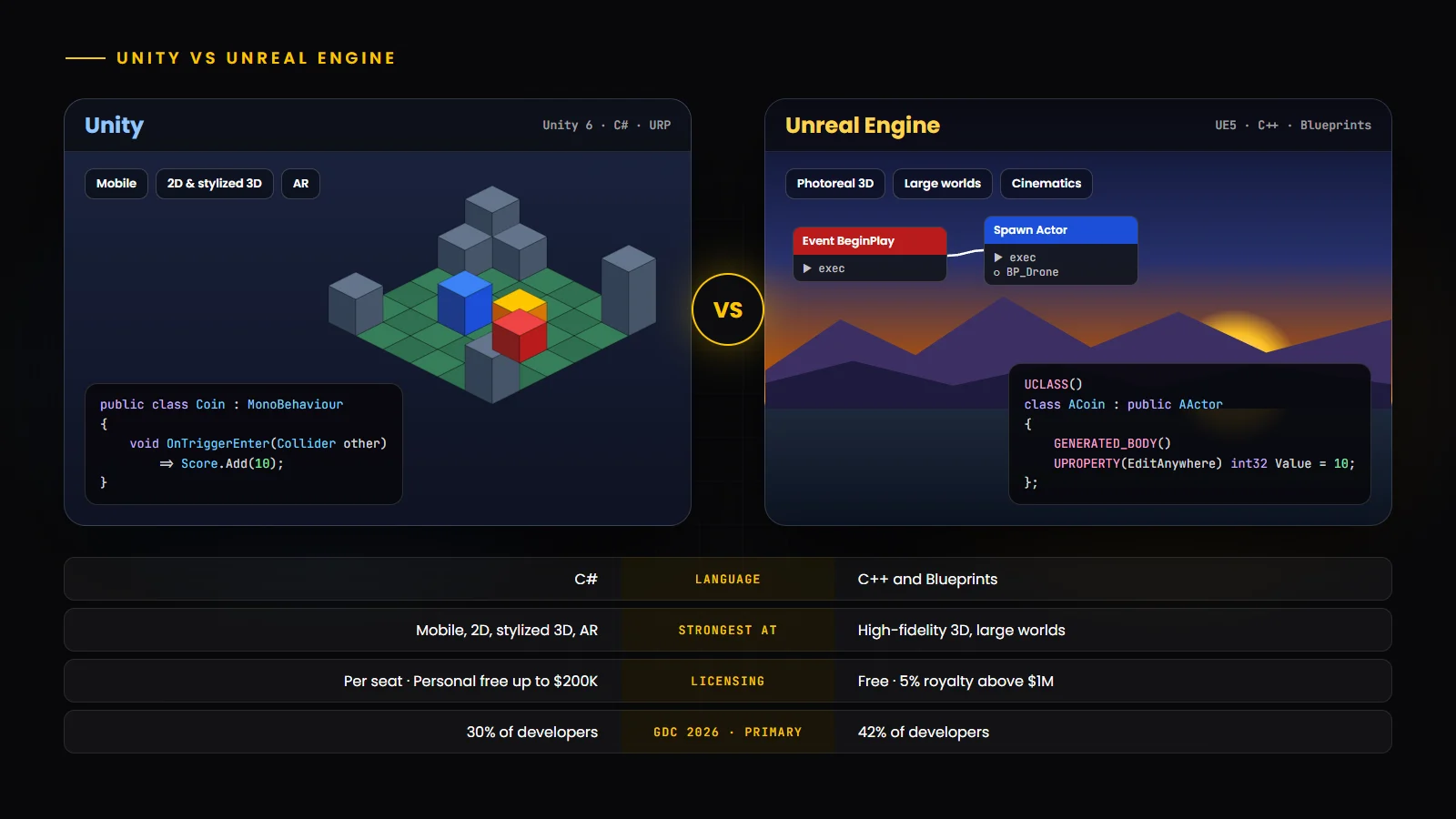
Unity vs Unreal Engine: the short answer
Unity and Unreal Engine are the two most widely used commercial game engines, and both can ship excellent games on mobile, PC and consoles. There is no universal winner. Unity is usually the better fit for mobile, 2D, stylized 3D, AR and smaller teams that want fast iteration. Unreal Engine is usually the better fit for high-fidelity 3D, large worlds, cinematic quality and teams with C++ experience.
The right choice depends on your game, your target devices, your team and your budget, not on which engine is more popular this year. This guide compares the two on the points that actually change outcomes, and ends with a simple way to decide. If you are planning a mobile title, our complete guide to mobile game development in 2026 covers the wider process.
What is Unity?
Unity is a cross-platform game engine programmed in C#. It is known for a lightweight runtime, strong 2D and 3D tools, a large asset store and wide platform support, and it has long been the most common engine on mobile. Unity 6 is the current generation: Unity 6.3 LTS, released in December 2025, is the current long-term support release, Unity shipped further 6.x updates during 2026, and Unity has said the next LTS release will be Unity 6.7.
Unity offers two main render pipelines: the Universal Render Pipeline (URP), which scales from mobile to PC, and the High Definition Render Pipeline (HDRP) for high-end PC and console visuals.
What is Unreal Engine?
Unreal Engine is Epic Games’ engine, programmed in C++ with Blueprints visual scripting on top. It is known for state-of-the-art real-time rendering, tools for building large and realistic worlds, and the same technology Epic uses for its own games. Unreal Engine 5.8, released in June 2026, made MegaLights production-ready and added Lumen Lite, a performance-focused lighting mode. Epic has described 5.8 as the last planned major Unreal Engine 5 release as work on Unreal Engine 6 ramps up.
Unreal includes most tools in the box, from character and animation systems to world building, physics and networking, which makes it powerful but also heavier to learn and to run.
Unity vs Unreal Engine at a glance
The table below summarizes the key technical and commercial differences.
Aspect | Unity | Unreal Engine |
|---|---|---|
| Programming | C# | C++ and Blueprints visual scripting |
| Rendering | URP for mobile to PC, HDRP for high-end | Nanite, Lumen and MegaLights for high-end; a mobile renderer for phones |
| Strongest at | Mobile, 2D, stylized 3D, AR and XR | Photoreal 3D, large worlds, cinematics |
| Runtime footprint | Lighter builds that suit lower-end devices | Heavier by default; needs tuning for mobile |
| Multiplayer | Netcode for GameObjects and Entities, Unity multiplayer services | Built-in replication and dedicated server support |
| Marketplace | Unity Asset Store | Fab, Epic’s content marketplace |
| Licensing for games | Per-seat subscriptions; Unity Personal free up to $200,000 in revenue and funding | Free to use; 5% royalty on lifetime gross revenue above $1 million per product |
Market adoption in 2026
The GDC 2026 State of the Game Industry survey, based on responses from more than 2,300 game industry professionals, found that 42% of developers named Unreal Engine as their primary engine, ahead of Unity at 30%. Unreal adoption was higher at AA (59%) and AAA (47%) studios, while 54% of developers at older indie studios were still using Unity, and Godot had gained some use with newer indie developers (11%).
These are survey figures about developers’ primary engines, not a count of shipped games, and Unity remains widely used for mobile and smaller-team projects. Popularity is a useful signal for hiring and ecosystem health, but it should not decide your engine on its own.
Graphics and rendering
Unreal Engine leads on high-end visuals. Nanite virtualized geometry handles extremely detailed scenes, Lumen provides dynamic global illumination and reflections, MegaLights renders many dynamic shadowed lights, and the Substrate material system builds complex materials. For photoreal environments, realistic characters and cinematic lighting on modern PCs and consoles, Unreal gets teams there faster.
Unity is very capable but optimized for flexibility. URP delivers good-looking stylized and realistic visuals across a wide range of devices, with tools such as Shader Graph, VFX Graph and the GPU Resident Drawer. HDRP targets high-end platforms. Many of the most visually distinctive games use stylized art, where Unity is entirely competitive and often easier to optimize.
Performance and optimization
Both engines can run fast, and both can run badly. Performance depends far more on content budgets and engineering discipline than on the engine’s name. The real difference is the starting point: Unity starts lighter and lets you add features, while Unreal starts feature-rich and asks you to scale down for weaker hardware.
For high-end PC and console games, Unreal’s rendering features can deliver visual quality per frame that would take much more work in Unity. For mid-range Android phones, Unity typically reaches a stable frame rate and small app size with less effort. Whichever you choose, profile early on real target hardware with the Unity Profiler or Unreal Insights and set budgets for draw calls, memory and frame time.
Unity vs Unreal for mobile games
Mobile is where the difference is clearest. Unity remains the default for most mobile games because of its lighter runtime, smaller builds, mature 2D and URP pipelines, and broad support from ad, analytics, attribution and platform SDK vendors. It is also the more common choice for free-to-play casual and mid-core games, where reaching lower-end Android devices matters.
Unreal Engine is a strong choice for graphically ambitious mobile games, such as shooters and action titles aimed at mid-range and high-end phones. It requires careful use of the mobile renderer, scalability settings and device profiles, and more attention to package size. Both engines must keep up with store requirements, such as Google Play’s target API level and 16 KB memory page size rules and Apple’s Xcode 26 SDK requirement, which means staying on supported engine versions. Our mobile game development team works with both engines.
2D game development
For 2D games, Unity is the stronger of the two. It has a dedicated 2D toolset, including sprites, tilemaps, 2D lighting, 2D animation and 2D physics, which Unity 6.3 extended with a new API built on Box2D v3. Unreal can make 2D games, but its tools are built around 3D and it is rarely the first choice for a pure 2D project. Godot is also a good option for smaller 2D games. See our 2D game development services and our comparison of 2D vs 3D game development for more on that decision.
Programming languages and workflow
Unity uses C#, a modern, memory-managed language that most developers learn quickly. Iteration is fast, especially with Unity 6’s faster Enter Play Mode options, and it is easy to build custom editor tools for designers.
Unreal uses C++ for engine-level and performance-critical code, and Blueprints for visual scripting. Blueprints let designers build gameplay without writing code, which is a real advantage for some teams, while C++ gives full control at the cost of longer compile times and a steeper learning curve. Most professional Unreal projects combine both: systems in C++, exposed to Blueprints for designers.
Learning curve and hiring
Unity is generally easier to learn and has a large pool of C# developers, which helps small studios and companies building their first game. Unreal has a steeper curve, particularly for C++, but Blueprints make it accessible to designers and artists, and experienced Unreal developers are in demand at larger studios. Consider who will maintain the game after launch, not only who builds the first version.
Asset stores and ecosystem
Both ecosystems are large. Unity’s Asset Store offers a wide range of tools, templates, art and plugins, and almost every mobile SDK ships a Unity integration first. Epic’s Fab marketplace offers high-quality 3D content, and Unreal includes many systems in the engine that would be plugins in Unity. Plugins save time, but each one is a dependency you will need to update, so choose well-maintained ones.
Multiplayer and networking
Unreal Engine has a mature, built-in replication system and dedicated server support, refined over many years of Epic’s own online games. It is a strong foundation for competitive, server-authoritative 3D multiplayer.
Unity offers Netcode for GameObjects and Netcode for Entities, a distributed authority model for smaller sessions, and Unity’s multiplayer services for relay, lobbies and matchmaking. Unity ended direct support for its Multiplay game server hosting on March 31, 2026, licensing that technology to Rocket Science Group, so dedicated server hosting for Unity games now comes from third-party providers such as Amazon GameLift Servers. Third-party networking stacks such as Photon are also widely used with Unity. Our guide to multiplayer mobile game development covers architecture choices in depth.
AR, VR and XR
Unity is the more common choice for mobile augmented reality, thanks to AR Foundation, which targets ARKit and ARCore from one project, and for many standalone VR and mixed reality apps through the XR Interaction Toolkit. Unreal is used for high-end PC VR, virtual production and visualization where visual fidelity matters most. For more, see our AR development and VR development services.
Licensing and costs
Licensing is often misunderstood, so it is worth stating precisely. Unity charges per-seat subscriptions for its Pro and Enterprise plans, while Unity Personal is free for customers with up to $200,000 in revenue and funding over the last 12 months. Unity cancelled its controversial Runtime Fee in September 2024, before it took effect, so no Unity game pays a per-install fee.
Unreal Engine is free to download and use. For games, Epic’s standard license charges a 5% royalty on lifetime gross revenue above $1 million per product. Epic also offers a reduced 3.5% rate through its Launch Everywhere with Epic program for games that release on the Epic Games Store at the same time as other stores. Some non-game commercial uses are licensed per seat instead. Always check both companies’ current terms before you commit, because they do change.
Cost factor | Unity | Unreal Engine |
|---|---|---|
| Upfront engine cost | Free on Personal; per-seat subscription above the threshold | Free |
| Revenue share | None | 5% of lifetime gross above $1 million per product, or 3.5% if eligible |
| Best for low budgets | Small teams under the Personal threshold | Teams that expect modest revenue below $1 million |
| At commercial scale | Predictable per-seat cost regardless of revenue | Royalty grows with revenue |
Development cost and timelines
For most projects, engine licensing is a small part of the total budget. The bigger cost drivers are team skills, the amount and fidelity of 3D content, and optimization work. High-fidelity Unreal projects often spend more on art and on scaling content down for weaker devices, while Unity projects may spend more on plugins or custom rendering work when they push visual quality. Our article on how long mobile game development takes breaks down timelines by game type.
Which engine for which project?
The table below shows how we typically advise clients. It is a starting point, not a rule.
Project type | Usually the better fit | Why |
|---|---|---|
| Casual, puzzle or hybrid-casual mobile game | Unity | Light builds, fast iteration, SDK support |
| 2D game on any platform | Unity (or Godot) | Dedicated 2D tools |
| Mobile AR game | Unity | AR Foundation across ARKit and ARCore |
| Graphically ambitious mobile shooter or action game | Unreal or Unity | Depends on target devices and team |
| Photoreal PC or console game | Unreal Engine | Nanite, Lumen and world-building tools |
| Large open world with realistic characters | Unreal Engine | World Partition, MetaHuman, cinematics |
When to choose Unity
Mobile is your primary platform, or the game must run well on lower-end devices.
The game is 2D, stylized 3D or AR-first.
Your team works in C#, or you want the largest hiring pool.
You rely heavily on third-party mobile SDKs for ads, analytics and attribution.
You want predictable per-seat costs rather than a revenue royalty. Our Unity game development team can help you plan the project.
When to choose Unreal Engine
Visual fidelity is a core part of the game’s appeal.
You are building large or realistic 3D worlds for PC, console or high-end mobile.
Your team has C++ experience, or designers want Blueprints.
You need built-in cinematic, character and world-building tools.
You are comfortable with a royalty above $1 million in revenue. Our Unreal Engine game development team works across C++ and Blueprints.
What about Godot?
Godot is a free, open-source engine under the MIT license, with no fees or royalties. It is lightweight and a good fit for 2D and smaller 3D games, and its use is growing among newer indie developers. Its ecosystem of mobile SDK integrations and third-party tools is smaller than Unity’s or Unreal’s, which matters for commercial mobile games that rely on ads, analytics and platform services.
Should you switch engines mid-project?
Rarely. Moving an active project to another engine usually means rebuilding most of the code, shaders and tools, and only the raw art carries over. The better approach is to make the engine decision early with a prototype or vertical slice on your target devices, and to switch only if that test shows the engine cannot meet a core requirement.
Conclusion
In 2026, Unity and Unreal Engine are both excellent, but they are optimized for different games. Choose Unity for mobile, 2D, stylized 3D, AR and lean teams that need fast iteration. Choose Unreal Engine for high-fidelity 3D, large worlds and cinematic quality. Decide with a prototype on real target hardware, check current licensing terms, and plan for the team that will maintain the game after launch.
Build Your Game With the Right Engine
Not sure which engine fits your idea? HBOX Digital builds games in both Unity and Unreal Engine, and we will recommend the engine that fits your game, devices and budget, not the one we prefer. Explore our game development company services or talk to us about your project.