
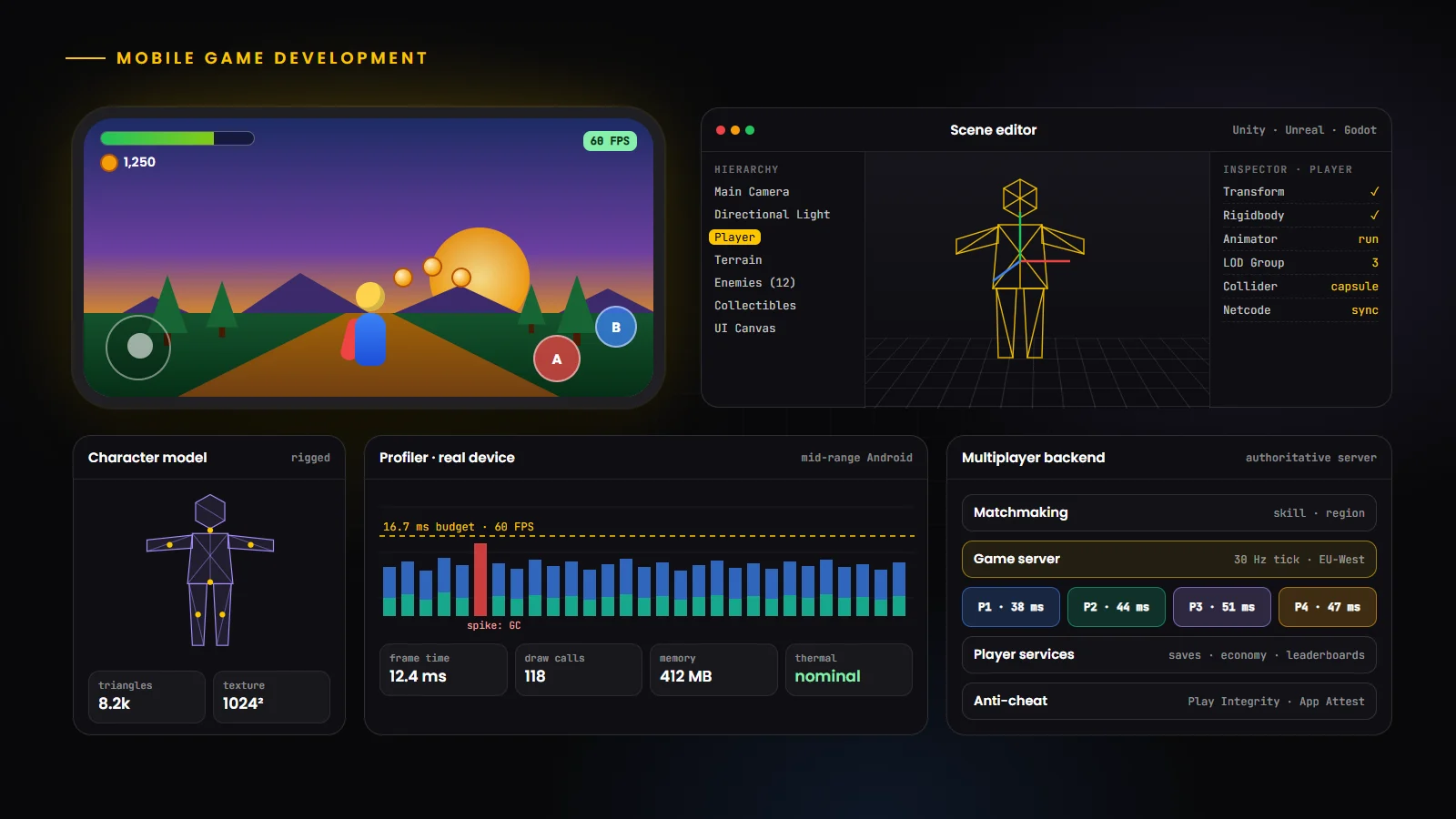
What is mobile game development?
Mobile game development is the process of designing, building, testing, launching and operating games for smartphones and tablets, mainly on Android and iOS. It combines game design, art, animation, audio, programming, backend services, analytics and monetization, and unlike most apps, a successful mobile game is rarely finished at launch: it is updated and tuned for years.
Mobile is also the largest part of the games market. According to Newzoo figures reported by PocketGamer.biz, global games revenue passed $200 billion in 2025, with mobile games generating about $113 billion, roughly 56% of the total. Newzoo’s figures exclude advertising revenue, which is a major income stream for many mobile games.
This guide walks through the full picture, from genres, engines and platform requirements to multiplayer, performance, monetization, costs and how to choose a development partner. For a step-by-step view of taking a single game from idea to launch, see our mobile game app development guide.
Mobile gaming industry trends in 2026
Steady growth, high competition: mobile revenue is still growing, and Newzoo forecasts mobile games revenue of about $121 billion in 2026. That is a forecast, not a measurement, and growth is concentrated in games that retain players for months or years. Discoverability and user-acquisition costs remain the biggest challenges for new titles.
Hybrid monetization: many games now combine in-app purchases, rewarded ads and subscriptions or season passes, rather than relying on a single model.
Engines with long-term support: Unity released Unity 6.3 LTS in December 2025, its first long-term support release since Unity 6.0, and Epic released Unreal Engine 5.8 in June 2026, which it describes as the last planned major Unreal Engine 5 release before Unreal Engine 6.
Generative AI, with caution: in the GDC 2026 State of the Game Industry survey, 36% of game industry professionals said they use generative AI tools in their job, while 52% said they believe generative AI is having a negative impact on the industry. Studios are using it mostly for prototyping, research and internal tooling, and treating player-facing use carefully.
Stricter platform requirements: Google Play and Apple raised technical requirements in 2025 and 2026, from target API levels and 16 KB memory pages on Android to building with Xcode 26 on iOS. Engines and SDKs must be kept current to keep shipping updates.
Cross-platform play: more mobile games share accounts and progress with PC or console versions, which raises the bar for backend architecture and UI that adapts to different screens and inputs.
Popular mobile game genres
Genre shapes almost every decision that follows, from art style and engine to session length, backend and monetization. The table below summarizes common mobile genres.
Genre | Typical play pattern | Common monetization |
|---|---|---|
| Hyper-casual and hybrid-casual | Very short sessions, one simple mechanic; hybrid-casual adds progression and meta systems | Ads first, with growing use of in-app purchases |
| Puzzle (match-3, merge, word) | Short levels, long-term progression, events | In-app purchases for boosters and lives, plus rewarded ads |
| Strategy and 4X | Base building, resource management, alliances | In-app purchases and passes; high spending per payer |
| RPG and gacha | Character collection, upgrades, story and events | Randomized item draws, passes and bundles |
| Shooters, MOBA and battle royale | Real-time multiplayer matches | Cosmetics and battle passes |
| Simulation, idle and tycoon | Progress that continues offline, frequent check-ins | Rewarded ads and in-app purchases |
| Sports and racing | Matches, seasons and team building | In-app purchases, passes and licensed content |
2D vs 3D mobile game development
2D games use sprites, tile maps and 2D physics. They are generally faster and cheaper to produce, run well on lower-end devices, and suit puzzle, casual, platformer and many strategy games. Strong art direction can make a 2D game look premium without a large budget. Our 2D game development team works across these styles.
3D games use models, materials, lighting and cameras in three dimensions. They enable immersive worlds, shooters, racing and action games, but need more art production, more optimization work and closer attention to device performance and app size. See our 3D game development services for that end of the spectrum.
Many successful mobile games mix both, for example a 3D world with a 2D interface, or 2.5D games with 3D models on a fixed camera. Our detailed comparison of 2D vs 3D game development covers the trade-offs in more depth.
Unity vs Unreal Engine
Unity and Unreal Engine are the two most widely used commercial engines for mobile games, and the open-source Godot engine is a growing alternative for smaller projects. The comparison below focuses on factors that matter for mobile.
Aspect | Unity | Unreal Engine | Godot |
|---|---|---|---|
| Programming | C# | C++ and Blueprints visual scripting | GDScript, C# and C++ via extensions |
| Mobile strengths | Very broad mobile adoption, lightweight builds, strong 2D and 3D, large asset store | High-end 3D visuals and tools for large, realistic worlds | Lightweight, fast iteration, good for 2D and smaller 3D games |
| Typical fit | Casual to mid-core and many 3D mobile games | Graphically ambitious mid-core and core games | Indie and smaller projects |
| Licensing model | Subscription plans per seat; Unity Personal is free below a revenue threshold | Free to use; 5% royalty on lifetime gross revenue above $1 million per product | Free and open source under the MIT license |
| Considerations | Choose an LTS release and plan upgrades | Larger builds and more optimization for mid-range phones | Smaller ecosystem of plugins and mobile SDK integrations |
How to choose an engine
Choose based on the game, the team and the target devices. Unity is the safest default for most mobile games because of its mobile track record, tooling and SDK support; Unity cancelled its controversial Runtime Fee in 2024 and moved back to subscription pricing. Unreal Engine is a strong choice for visually ambitious 3D games when the team has C++ experience and is ready to optimize carefully for mid-range Android devices; Epic also offers a reduced royalty for games that meet its Epic Games Store launch conditions. Godot suits smaller teams that value a free, open engine. Always confirm current licensing terms on the vendor’s website before committing. Our detailed comparison of Unity vs Unreal Engine in 2026 goes deeper into this decision.
Android and iOS game development
Android game development means supporting a very wide range of devices, GPUs and memory sizes. Plan a device matrix that reflects your audience, use Vulkan where it performs well with OpenGL ES as a fallback where needed, and test on real low- and mid-range phones. Google Play requires new apps and updates to target Android 16 (API level 36) from August 31, 2026, and apps targeting Android 15 or higher must support 16 KB memory page sizes, which affects every game, because engines ship native code. Staying on a supported engine version is the simplest way to comply.
iOS game development targets a smaller set of devices with Apple’s Metal graphics API, which makes performance more predictable. Since April 28, 2026, Apple has required App Store uploads to be built with Xcode 26 and the iOS 26 SDK. Plan for Game Center integration, App Store privacy labels and Apple’s review guidelines from the start.
Cross-platform mobile game development
Game engines are cross-platform by design: one Unity, Unreal or Godot project builds for Android and iOS, and often for PC, consoles and the web as well. The shared part is the game itself; platform-specific work still includes store billing, sign-in, notifications, achievements, performance tuning per device class and compliance with each store’s rules.
For simple casual or educational games embedded in a larger app, app frameworks can also work; Flutter, for example, has the Flame game engine. Our comparison of Flutter vs React Native explains those frameworks in more detail. For anything beyond light casual play, a dedicated game engine is the better tool.
Game mechanics and player engagement
Every successful mobile game is built around a strong core loop: the short cycle of actions a player repeats, such as match, earn, upgrade, repeat. Around it sit progression systems that give long-term goals, social features that bring friends and competition, and live events that give players a reason to return.
The first-time user experience is critical, because many players decide within minutes whether to keep a game. Teach by playing rather than with long tutorials, reach the fun quickly, and delay complex systems until players are invested. Measure retention at day 1, day 7 and day 30, and use playtests and analytics to find where players drop off.
Multiplayer game architecture
Multiplayer design starts with the type of interaction. Asynchronous multiplayer, such as turn-based play, leaderboards and guild events, can run on standard web backends. Real-time multiplayer, such as shooters, racing or MOBA games, needs low-latency networking and careful architecture. Our guide to multiplayer mobile game development covers netcode, servers and costs in depth.
Competitive real-time games normally use an authoritative server: the server runs the simulation and decides what happened, and clients send inputs and display the result. This protects against cheating at the cost of hosting dedicated servers. Cooperative or casual games can use relay services or host-based models to reduce cost. Matchmaking, lobbies, parties, chat and reconnection handling complete the system.
Service | Typically used for |
|---|---|
| Unity Gaming Services | Netcode for GameObjects and Entities, Relay, Lobby, Matchmaker, Cloud Save and other services integrated with Unity |
| Photon (Fusion, Quantum) | Hosted real-time networking engines, popular for fast-paced and deterministic multiplayer |
| Nakama by Heroic Labs | Open-source game server for accounts, social features, matchmaking, chat and leaderboards |
| Microsoft PlayFab | Managed backend for player accounts, economy, live ops and analytics |
| Epic Online Services | Free cross-platform services such as accounts, friends, lobbies and achievements |
| Amazon GameLift Servers | Hosting and scaling dedicated game servers on AWS |
Real-time networking and backend development
Real-time games send small, frequent updates, usually over UDP-based protocols, at a fixed tick rate. Techniques such as client-side prediction, server reconciliation, interpolation and lag compensation hide network latency so the game feels responsive on mobile connections that fluctuate between Wi-Fi and cellular.
Beyond the match itself, the game backend handles accounts, cloud saves, inventories and virtual currencies, purchase validation, leaderboards, events, configuration that can change without a store update, and analytics. Validate purchases and important game state on the server, never trust the client, and use device integrity checks such as Google’s Play Integrity API and Apple’s App Attest to make cheating and fraud harder.
Game physics and animation
Engines include physics systems for collisions, rigid bodies and ragdolls; Unity 6.3, for example, added a new 2D physics API built on Box2D v3. On mobile, keep physics simulations small: use simple collider shapes, limit the number of active bodies and avoid physics where scripted movement will do.
Animation brings characters and interfaces to life. Skeletal animation with state machines and blend trees handles characters, while tweening handles UI and simple objects. Budget animation carefully: bone counts, the number of animated characters on screen and animation compression all affect performance and memory on mid-range devices.
Character design and 3D environments
Art production follows a pipeline: concept art, modelling, texturing, rigging, animation and integration into the engine. For mobile, define technical budgets before production starts, such as polygon counts per character, texture sizes, material counts and draw calls per scene, so artists create assets that will actually run well.
Environments use modular kits, texture atlases, baked lighting where possible and levels of detail (LODs) that swap in simpler meshes at a distance. A consistent, stylized art direction often looks better on small screens and performs better than chasing photorealism.
AI integration in game development
AI in games covers two different things. Game AI drives behaviour inside the game: pathfinding, behaviour trees and state machines for enemies and companions, difficulty that adapts to the player, and procedural generation of levels and content. These techniques are mature and run on the device.
Generative AI is increasingly used in production for prototyping ideas, generating placeholder art and dialogue, writing and testing code and analysing player feedback. Player-facing generative features, such as conversational characters, require care around cost, latency, content safety and platform rules. Our article on artificial intelligence in modern game development explores these uses in more depth.
AR integration in mobile games
Augmented reality places game content in the real world through the phone camera. Apple’s ARKit and Google’s ARCore provide motion tracking, plane detection and light estimation, and Unity’s AR Foundation lets one project target both. Location-based AR games add maps and real-world points of interest on top.
The category remains commercially significant: in 2025 Niantic agreed to sell its games business, including Pokémon GO, to Scopely, and spun out its geospatial technology as Niantic Spatial. For a wider view of the technology, see our guide to AR/VR app development in 2026 and our AR development services.
Mobile game performance optimization
Mobile games must hit their frame rate on devices that heat up, throttle and run on battery. At 60 frames per second, each frame has about 16.7 milliseconds for game logic, physics, animation and rendering; at 120 frames per second, about 8.3 milliseconds.
Rendering: reduce draw calls with batching and GPU instancing, limit real-time lights and shadows, use compressed textures such as ASTC, and keep overdraw low, especially with transparent effects and UI.
CPU and memory: avoid per-frame allocations that trigger garbage collection, pool frequently created objects, and stream or unload assets to stay within memory limits on lower-end devices.
Thermals and battery: offer frame-rate and quality settings, cap the frame rate where higher rates add little, and test long play sessions, not only the first minutes.
App size: compress assets, remove unused content and deliver optional content after install, for example through Play Asset Delivery or on-demand resources.
Measure, do not guess: use the Unity Profiler, Unreal Insights, Android GPU Inspector and Xcode Instruments on real devices to find actual bottlenecks.
Game monetization models
Monetization should be designed into the game from the start, because it shapes progression, economy and player trust. The main models are summarized below.
Model | How it works | Works well for |
|---|---|---|
| Premium | Players pay once to download | Niche, narrative or established-brand games |
| Free-to-play with in-app purchases | Free download; players buy currency, items, boosters or content | Puzzle, strategy, RPG and many mid-core games |
| Advertising | Interstitial, banner and rewarded video ads, usually through ad mediation | Casual and hyper-casual games with large audiences |
| Subscriptions and passes | Recurring or seasonal payments for rewards, perks or ad removal | Games with regular content updates and engaged players |
| Hybrid | A mix of purchases, rewarded ads and passes | Most modern free-to-play games |
In-app purchases and subscriptions
Digital goods sold inside a game generally must use the platform’s billing system, Google Play Billing on Android and Apple’s In-App Purchase on iOS, subject to regional rules and exceptions that have changed in recent years. Both stores offer a reduced 15% commission for smaller developers: Apple through its App Store Small Business Program and Google on the first $1 million of earnings each year.
Implement purchases with server-side receipt validation, handle refunds and restores correctly, and keep virtual economies balanced so that paying players feel rewarded without making the game unfair for others. Rewarded ads, where players choose to watch an ad for a reward, are generally the most player-friendly ad format and pair well with in-app purchases.
App Store and Google Play publishing considerations
Publishing involves more than uploading a build. Prepare store listings with screenshots, video and localized descriptions; complete privacy disclosures such as Apple’s privacy labels and Google Play’s data safety section; and complete age ratings, including Apple’s updated age rating system and the IARC questionnaire on Google Play.
Both stores require games that sell randomized virtual items, often called loot boxes, to disclose the odds before purchase. Plan for app review times, test with TestFlight and Google Play testing tracks, and consider a soft launch in a few markets to tune retention and monetization before a global release.
Mobile game development process
1. Concept: define the core idea, audience, genre, platforms and business model.
2. Prototype: build a quick, rough version of the core mechanic to test whether it is fun before investing in art.
3. Pre-production: write the game design document, choose the engine and backend, set technical budgets and plan production.
4. Vertical slice: complete one small part of the game at final quality to validate the art style, performance and pipeline.
5. Production: build content, features, backend services, monetization and analytics in iterative milestones.
6. Alpha and beta: complete features, fix bugs, run playtests and test on a wide device range.
7. Soft launch: release in selected markets, measure retention and monetization, and iterate.
8. Global launch and live operations: release worldwide, then keep updating with events, content and improvements.
Game development costs and timelines
Mobile game budgets vary enormously, so any honest estimate starts from the scope. The factors below determine cost and timeline far more than the platform itself.
Factor | Smaller scope | Larger scope |
|---|---|---|
| Game type | Single-mechanic casual or puzzle game | Mid-core or core game with several interlocking systems |
| Art | 2D or simple stylized 3D | Detailed 3D characters, environments and animation |
| Multiplayer | Single-player or asynchronous features | Real-time multiplayer with dedicated servers |
| Backend and live ops | Basic saves and analytics | Economy, events, matchmaking, anti-cheat and admin tools |
| Content | A focused set of levels | Large worlds, story, many characters and regular updates |
| Platforms and quality | One store and a narrow device range | Both stores, wide device support, localization and accessibility |
Planning a realistic timeline
Simple casual games can reach launch in a few months, while mid-core and multiplayer games commonly take a year or more, and live operations continue after launch. Our article on how long mobile game development takes breaks timelines down by game type. Budget not only for development but also for user acquisition, live operations and ongoing updates, which for many successful games exceed the original build cost over time.
Game testing and quality assurance
Game QA covers functionality, gameplay balance, performance, compatibility and compliance. Test on a matrix of real devices that reflects your audience, including older and lower-memory phones. Combine automated tests for game logic and backend services with manual exploratory testing, structured playtests with real players, and performance tests over long sessions.
Before submission, check store compliance items such as purchase flows, privacy disclosures, age ratings and odds disclosure, and test edge cases such as interrupted purchases, poor connectivity and app backgrounding.
Post-launch game maintenance
Launch is the start of a game’s life, not the end. Live operations include regular events and content, balance changes informed by analytics, monitoring of crashes and performance, customer support and community management. Remote configuration lets teams tune difficulty, offers and events without a store update.
Technical maintenance continues too: new OS versions, new store requirements, engine and SDK updates, security patches and backend scaling. Studios that plan for this from the start keep their games healthy and profitable for longer.
Choosing a mobile game development company
Look for a studio with shipped mobile games in a similar genre, experience with your chosen engine, and the ability to cover art, development, backend and live operations, or to work smoothly with your own team. Ask how they prototype and validate fun early, how they test performance on low-end devices, how they handle store compliance, and what support they provide after launch.
A good partner will challenge your scope where needed, propose a prototype or vertical slice before full production, and be transparent about the trade-offs between quality, time and budget. If your game is part of a wider product with companion apps or web features, a team that also delivers mobile app development can keep everything consistent.
Conclusion
Mobile game development in 2026 offers a huge audience and mature tools, but also intense competition and rising platform requirements. The games that succeed start with a fun, well-tested core loop, choose the engine and architecture that fit their scope, optimize for real devices, monetize in ways players trust and keep improving after launch.
Bring Your Mobile Game Idea to Life
From game concept to launch, explore professional 2D, 3D, Android and iOS game development solutions. Our game development company team handles prototyping, art, engineering, multiplayer backends and live operations, with dedicated mobile game development, Unity game development and Unreal Engine game development services.