What is MVP development?
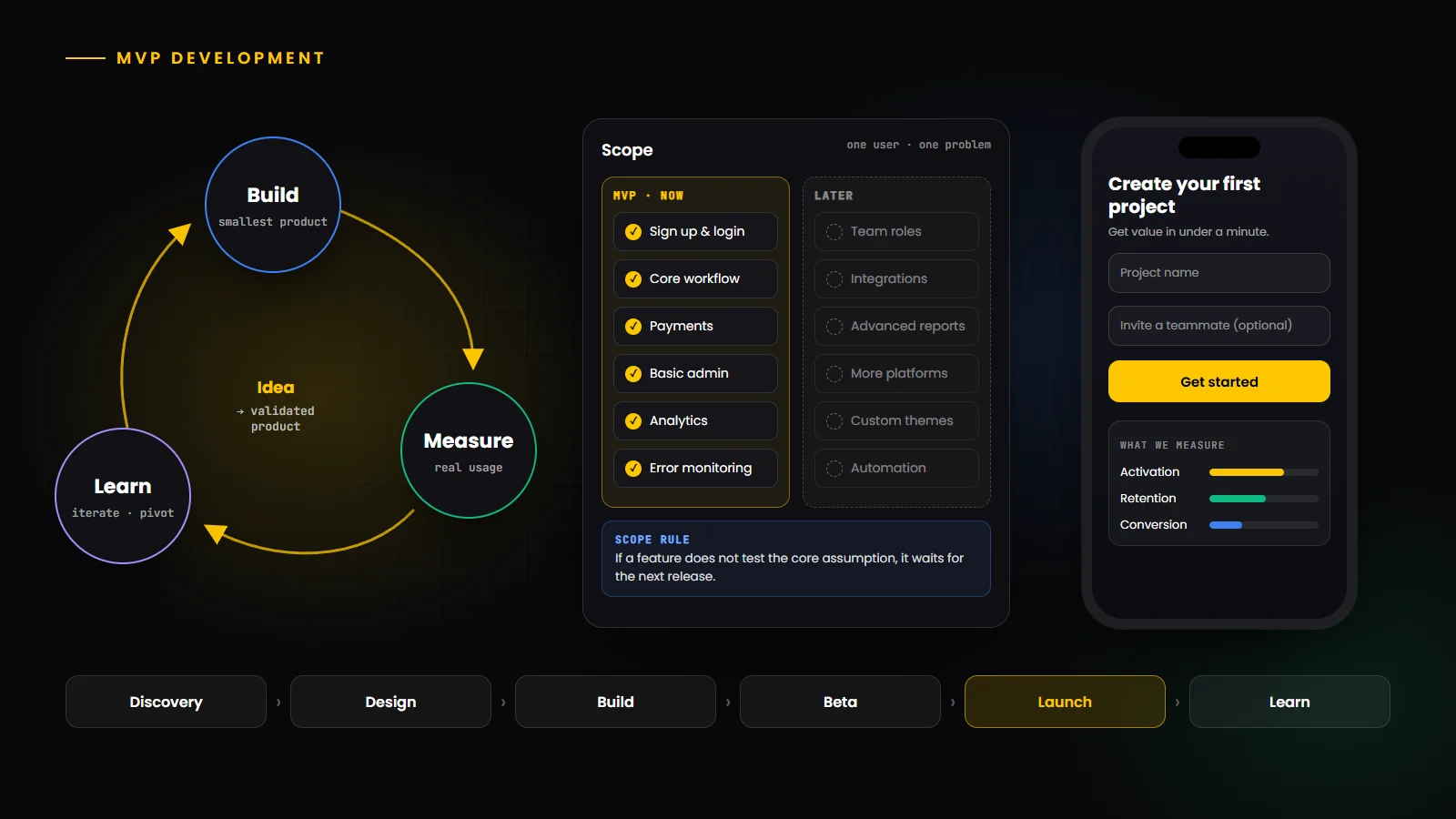
MVP development is the process of building a minimum viable product: the smallest version of a product that real users can use to solve one real problem, so you can learn whether the idea is worth building further. The term was popularized by Eric Ries in The Lean Startup, where the MVP is the fastest way to start the build–measure–learn loop with real customers.
The important word is viable. An MVP is not a half-finished app, a clickable mock-up or a list of features with the hard parts removed. It is a small product that works properly for a narrow job, for a specific group of people, well enough that they will actually use it, and ideally pay for it.
This guide explains how to decide what goes into an MVP, how it is built, what it costs, how to measure it and what to do once it is live. If you are deciding between building with code or a no-code tool, our comparison of no-code vs custom development is a useful companion.
Why an MVP matters more than ever in 2026
Most new products do not fail because the code is bad. They fail because not enough people want them. In CB Insights' analysis of 431 venture-backed startups that shut down since 2023, running out of capital was the final cause in 70% of cases, but poor product-market fit was the most common underlying reason, cited in 43%. An MVP exists to test product-market fit while it is still cheap to change course.
Building has also become faster. Modern frameworks, managed cloud services and AI coding assistants mean a focused team can ship a working product much sooner than a few years ago. That makes it tempting to build more. The opposite is usually right: when building is cheap, the expensive part is building the wrong thing, so learning fast matters more than shipping many features.
MVP vs prototype vs proof of concept
These three terms are often mixed up. They answer different questions and suit different stages.
Type | Question it answers | Who uses it | What it looks like |
|---|---|---|---|
| Proof of concept | Can this be built at all? | The internal team | A technical experiment, often throwaway |
| Prototype | Does the flow make sense to users? | Test users in sessions | Clickable design or rough app, no real data |
| MVP | Will real users adopt it, and pay? | Real customers, in real conditions | A small, working, reliable product |
| Full product | How do we grow and scale it? | A broad market | Complete feature set, operations, support |
Types of MVP
Not every MVP needs to be software. Choose the cheapest form that can answer your riskiest question.
Landing page or smoke test: a page that describes the product and asks people to sign up or pre-order. It tests demand before anything is built.
Concierge MVP: you deliver the service manually for a few customers. It teaches you exactly what the product must do before you automate it.
Wizard of Oz MVP: users see a product interface, but some of the work behind it is done by people. Useful for testing AI or automation ideas before investing in them.
Single-feature MVP: one core feature, built properly, that solves the main problem. This is the most common form of software MVP.
No-code or low-code MVP: built with visual tools for fast validation, with the understanding that a rebuild may be needed as you grow.
Piecemeal MVP: existing tools such as forms, spreadsheets, payment links and messaging stitched together to deliver the experience.
How to decide what goes into your MVP
Start with one user and one problem. Write down who the first users are, the job they are trying to get done, and what they use today. If you cannot describe the first 50 users specifically, the scope is not ready.
Find the riskiest assumption. Usually it is whether people want this enough to change their behaviour, not whether you can build it. Design the MVP to test that assumption first.
Map the core journey. List the steps a user takes from first visit to getting value. Everything on that path is a candidate for the MVP; everything off it waits.
Prioritize ruthlessly. Methods such as MoSCoW (must, should, could, won't) or RICE (reach, impact, confidence, effort) help, but the rule is simple: if the product still delivers its core value without a feature, the feature is not in the MVP.
Keep the non-negotiables. Security, data protection, payments that work and a smooth first experience are part of viable, not extras.
What to include and what to leave out
A quick reference for typical software MVPs:
Usually in the MVP | Usually later |
|---|---|
| The one core workflow that delivers value | Secondary workflows and nice-to-have features |
| Simple sign-up and secure login | Single sign-on for every provider, complex roles |
| Payments, if paying is part of the test | Coupons, multi-currency, complex billing |
| Basic admin tools for your own team | Full back-office dashboards |
| Product analytics and error monitoring | Advanced reporting for customers |
| One platform (web or one mobile platform) | Every platform at once |
The MVP development process
1. Discovery: define the problem, target users, value proposition, riskiest assumptions and success metrics. Talk to potential users before writing code.
2. Scope and plan: agree the core journey, the feature list, what is explicitly out of scope, and a short timeline with clear milestones.
3. Design: wireframes for the core flow, then a simple, consistent visual design. Test the prototype with a few target users and fix confusion early.
4. Build: develop in short sprints with a working build at the end of each one. Set up automated deployment, analytics and error monitoring from the first sprint.
5. Test: functional testing, security basics, performance on real devices and a small closed beta with friendly users.
6. Launch: release to a defined first audience, not the whole world. Make it easy for users to give feedback.
7. Measure and learn: track activation, retention and conversion, talk to users weekly, and decide whether to iterate, pivot or double down.
Our MVP development services follow this process, with discovery and validation built in before the main build starts.
Choosing a tech stack for your MVP
The best MVP stack is the one your team can build quickly, run cheaply and grow without a rewrite. Popular, well-supported choices in 2026 include:
Layer | Common choices | Why they suit MVPs |
|---|---|---|
| Web app | Next.js and React with TypeScript | Fast to build, SEO-friendly, one language across front and back end |
| Mobile app | React Native (with Expo) or Flutter | One codebase for iOS and Android |
| Back end | Node.js, Python, or a backend-as-a-service such as Supabase or Firebase | Quick APIs, auth and storage without heavy infrastructure |
| Database | PostgreSQL (managed) | Reliable, flexible and scales well past the MVP stage |
| Payments | Stripe or a regional payment provider; App Store and Google Play billing for in-app digital goods | Secure, compliant payments without building your own |
| Hosting | Vercel, AWS, Google Cloud or Azure managed services | Automatic deployments and pay-as-you-grow pricing |
Web or mobile first?
Start where your users already are. Many B2B products start as a web app, because it is faster to update and easier to sell. Consumer products that rely on notifications, the camera or daily habits often start on mobile, usually with one cross-platform codebase. Our comparison of Flutter vs React Native covers the main cross-platform options.
Using AI in MVP development
AI helps in two ways. First, it speeds up building: AI coding assistants help developers write, test and refactor code faster, and design tools turn sketches into prototypes quickly. The time saved should go into talking to users, not into adding features.
Second, AI can be the product itself or a key feature, such as a support assistant, document processing or smart search. For an MVP, use hosted models through an API rather than training your own, keep a human in the loop for important decisions, and track the cost of every AI call from day one. Our guide to AI mobile app development covers how to add AI features responsibly.
MVP development cost
There is no fixed price for an MVP, because cost depends on scope far more than on the label. The factors below move the budget most. A focused MVP built around one core workflow costs a fraction of a full product.
Cost factor | Lower cost | Higher cost |
|---|---|---|
| Scope | One core workflow | Several workflows and user types |
| Platforms | One web app or one cross-platform app | Separate native iOS, Android and web apps |
| Integrations | Payments and email only | CRM, ERP, banking or healthcare systems |
| Design | Clean, standard components | Highly custom, animated interfaces |
| Compliance | Standard data protection | Regulated data such as health or finance |
| AI | No AI, or one feature on a hosted model | Custom models, agents and evaluation pipelines |
How long does it take to build an MVP?
A focused MVP is usually measured in weeks to a few months, not a year. Discovery and design typically take a few weeks, the core build takes most of the time, and testing and a closed beta come before launch. If an MVP plan stretches toward a year, the scope is almost certainly too big. Our article on what goes into app development costs explains how scope affects both budget and timeline.
Metrics that show whether your MVP is working
Activation: the share of new users who reach the core value moment, such as creating their first project or completing their first order.
Retention: the share of users who come back after one week and after one month. Strong retention is the clearest early sign of product-market fit.
Conversion: the share of users who pay, upgrade or request a sales call.
Qualitative feedback: what users say they would miss if the product disappeared, and what they ask for repeatedly.
Unit economics: early signals of what it costs to acquire and serve a customer compared with what they pay.
Set target numbers before launch, so you can decide honestly whether the MVP has proved the idea.
Common MVP mistakes
Building too much: adding features to feel ready. Every extra feature delays learning and adds maintenance.
Building too little: a product so rough that users leave for reasons unrelated to the idea. Viable means reliable for the core job.
Skipping discovery: writing code before talking to users and confirming the problem is real.
No measurement: launching without analytics or success criteria, so nobody can tell whether it worked.
Ignoring the foundation: insecure logins, lost data or a database design that forces a rewrite as soon as users arrive.
Launching to everyone: a broad launch dilutes feedback. Start with a narrow audience that has the problem most acutely.
After the MVP: iterate, pivot or scale
When users activate, return and pay, it is time to strengthen the foundation and expand carefully, adding features that existing users ask for most. When results are mixed, iterate on onboarding and the core flow before adding anything new. When the core assumption is clearly wrong, a pivot to a different user, problem or solution is cheaper now than later.
Either way, the MVP stage ends when you are building a product rather than testing an idea. Our article on building software vs building a product explains that shift.
How to choose an MVP development company
Look for a partner that challenges your scope rather than inflating it, starts with discovery, has shipped MVPs in a similar market, builds on a mainstream stack you can hire for later, sets up analytics and monitoring as standard, and gives you full ownership of the code and accounts. Ask how they decide what to leave out, and how they will help you measure results after launch.
If you already have a product team, you can also add specialists to it instead of outsourcing the whole build, for example through full stack developers who can own both the front end and the back end of an MVP.
Conclusion
MVP development in 2026 is about learning, not just launching. Choose one user and one problem, build the smallest product that solves it reliably, measure what users actually do, and let the results decide what comes next. Done well, an MVP saves months of building the wrong thing and gives investors and your team real evidence to act on.
Turn Your Idea Into a Working MVP
HBOX Digital helps founders and businesses go from idea to a launched MVP, with discovery, design, development and the analytics to prove traction. Explore our MVP startup development approach or talk to us about your idea.