
01
End-to-end development capability
One developer or team takes a feature from the screen to the database, so there are fewer hand-offs and less waiting between teams.
Full stack development
Build powerful web applications with experienced full stack developers who bring together modern frontend interfaces, reliable backend systems, and scalable cloud architecture.
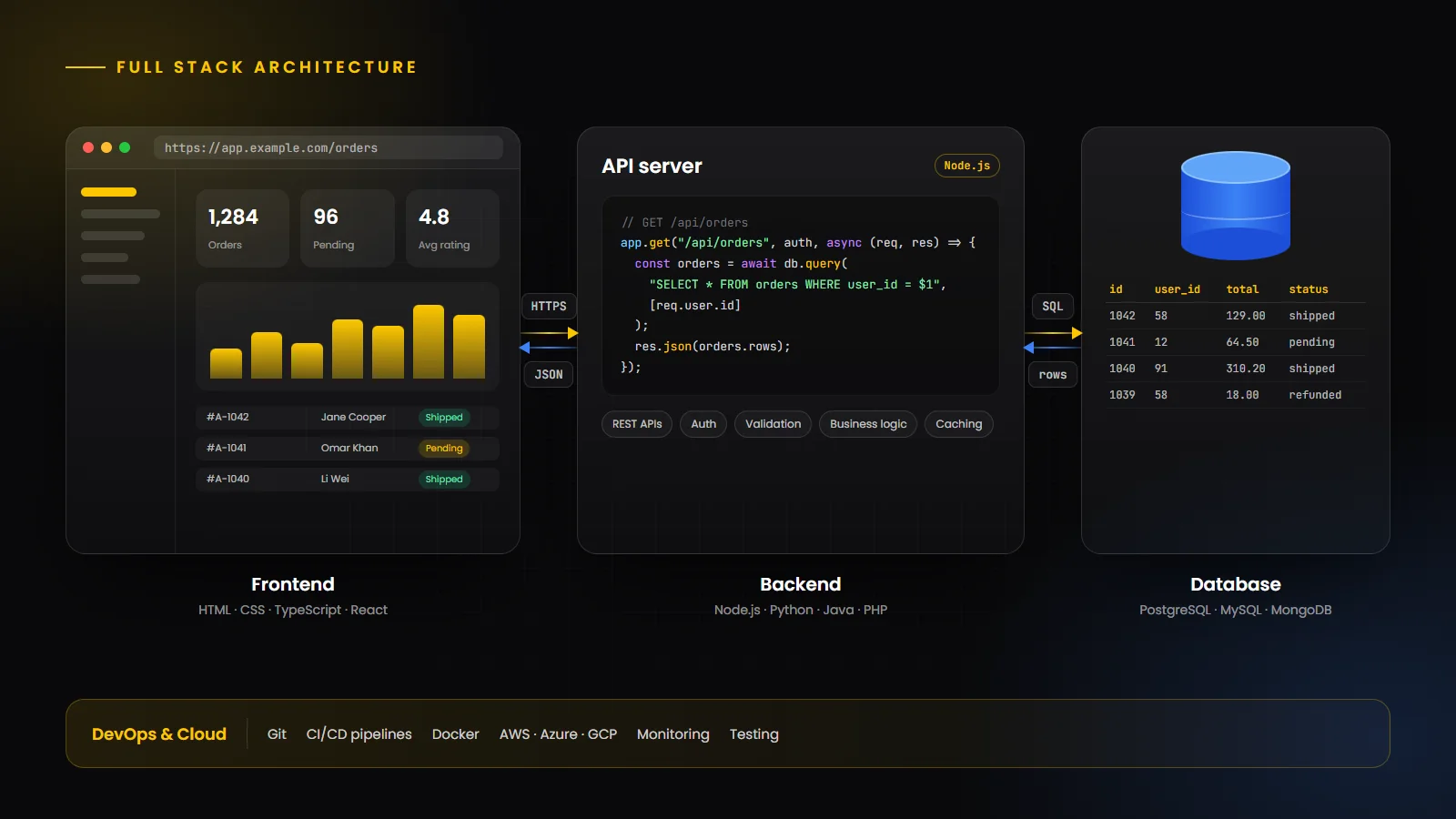
Illustration: a full stack application shown as a browser frontend, a backend API server and a database, all running on a cloud platform, with requests travelling from the frontend to the database and responses travelling back.
Overview
Full stack development is building every layer of a web application: the interface people use, the server logic and APIs behind it, the database that stores its information, and the cloud setup that runs it all. A full stack developer works across those layers, so a feature can move from idea to production without waiting on separate teams. Our guide explains what a full stack developer does in more detail.
Many teams use one language across the stack, such as TypeScript with React.js and Node.js, or build both sides in one framework, as in full stack development with Next.js. For larger systems, our full stack developers also work within custom software development teams alongside specialists.
One person or team owns a feature from the screen to the database.
Working screens arrive early, so you can review real software, not documents.
The interface and the data model are planned together, so they fit.
The calendar screen, the availability API and the bookings table change together when you add a new service.
Sign-in, invoices and support tickets, with each customer seeing only their own data.
Figures from several systems in one view, with separate permissions for managers and staff.
Services
Hire full stack developers for a complete product or for one layer of it. Each service shows which parts of the application it covers.
Web applications designed around your workflows and built end to end, from the interface to the database.
Responsive, accessible interfaces in React.js and Next.js, built from a reusable component system.
Server-side business logic, authentication and background jobs in Node.js, Express.js or Laravel.
Documented, versioned APIs that your web app, mobile apps and partners can all rely on.
Data models, migrations and queries designed for correctness first, and for speed as your data grows.
Multi-tenant products with sign-up, subscriptions, onboarding and the admin tools to run them.
Containerized deployments on AWS, with automated pipelines from pull request to production.
Keep existing applications secure and current, or move legacy code to a modern stack step by step.
Custom Web Application Development
Web applications designed around your workflows and built end to end, from the interface to the database.
What is included
Layers covered
Web application development servicesTechnology
Four layers, one product. Pick a layer to see the tools our full stack developers use there; we match developers to the stack you already run.
Everything the user sees and touches, built as typed, reusable components.
Need a specialist for one layer? Hire dedicated Node.js developers or Next.js developers.
Why HBOX Digital
Developers who think about the whole product, not just their part of it, and who fit into the way your team already works.
See how our engineers work inside client teams in our case studies, or explore our web application development services.
One developer or team takes a feature from the screen to the database, so there are fewer hand-offs and less waiting between teams.
Data models, APIs and hosting are planned together, so the app can grow in users and features with fewer rewrites later.
Typed code, consistent conventions, code review and automated tests, so your own team can keep building on it.
Payments, CRMs, maps, email and other third-party services, plus APIs designed to serve both web and mobile apps.
Developers join your standups, tools and sprint reviews, and share progress you can see in working software.
Validated inputs, authorization on every endpoint, careful handling of secrets, and attention to load times and Core Web Vitals.
Start with one dedicated developer, a project team or extra capacity for your own team, and change as your roadmap changes.
Maintenance, updates and new features after launch, with documentation that makes any future handover clean.
Interactive architecture
Pick an everyday action and follow the request through each layer of the application, then watch the response travel back. Select any layer to jump to it.
Step 1 of 6Request → User Interface
A customer types their email and password and presses Sign in.
What people see and tap: screens, buttons and forms.
Industries
Full stack development looks different in every sector. These are the products our developers are most often asked to build.
Development process
Six stages from first conversation to a live product. Each one ends with something you can see and review.
Step 01
We learn your goals, users and constraints, and agree what the first release must do.
Step 02
Wireframes and designs for the key screens, plus the data model, API design and hosting plan.
Step 03
The interface is built as reusable, responsive components, connected to sample data first so you can review it early.
Step 04
APIs, business rules, authentication and the database are built and wired to the frontend.
Step 05
Automated tests, manual checks on real devices, a security review and performance testing before release.
Step 06
Automated deployment to the cloud, monitoring, and a plan for fixes and new features after launch.
Hiring models
Choose how much of the work you want to manage. You can change models as your product and team grow.
A full-time developer who works only on your product and joins your team's routines.
Best for: Ongoing products in active development
A defined scope delivered by our team, from planning to launch.
Best for: New builds or features with clear requirements
Add one or more developers to your existing team to fill a skill gap or add capacity.
Best for: Teams with a roadmap and too few hands
An ongoing team that plans, builds and maintains your product with you.
Best for: Businesses without an in-house tech team
Pricing depends on scope, seniority and engagement length. We share an estimate after a discovery call.
Case studies
Explore our development work and discover how thoughtful engineering can help turn complex business ideas into scalable applications.
4 documented case studies · 6 shipped products
Full stack developers can deliver complete features on their own, which suits startups, MVPs and products that change often. You coordinate fewer people, decisions about the interface and the data are made together, and a small team can cover more of the product. On larger systems, they also work well alongside frontend and backend specialists.
Start a project
Work with HBOX Digital to develop reliable, scalable, and high-performing web applications.